Robbing Time

I’m working all May on marking. It’s Thursday, my movie day, and I haven’t even showered yet (it’s nearly noon) because I’ve been marking flat out since seven am. I’m marking, sending reminders for students to put their work up on the virtual learning environment, making little voice recordings of feedback, and coaching staff and students on upcoming assessments. I’m also dealing with the inevitable student complaints and trying to make sure that I’ve been fair, they’ve been fair and that nobody in my care will miss graduating because I didn’t work hard enough and quick enough.

If I work all of May and get my marking done, I’ll be able to write all of June and July. That’s right. I’ll spend every day with my heroine, as she remembers all the events of her past and makes the decisions for her people’s future. And that means, I’ll finish my current book and Sophie will have yet another project to send out to editors for me.

I’m robbing myself of time now, so that I can have more in the future. I’m investing time now, so that I can draw it out again then.

And isn’t that what writing is, really, anyway? Don’t we spend our lives, scribbling away, so that our voices and ideas live on? My books go places I’ve never been, meet people I’ve never met. When I’m dead, they might still be read. Some dusty shelf will be cleared and someone will pick it up and open the page and…I’ll be getting back some of the time I invested in its pages…
Knowing Your Breed

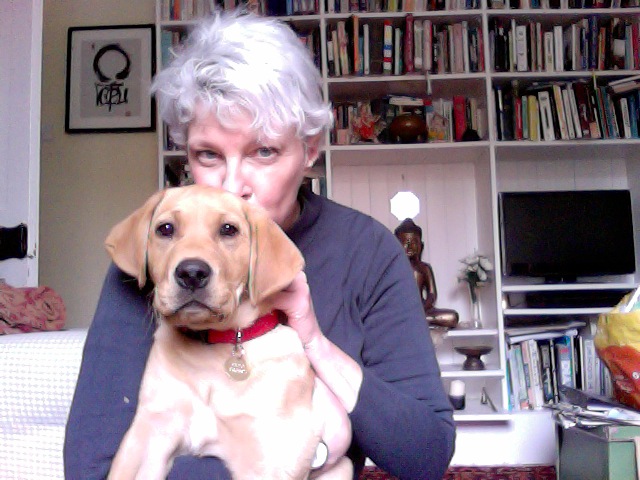
I’ve just been for a walk with Foyle, our 3 month old Labrador Puppy. It was our first walk to the other side of the river, where we met a lovely West Highland Terrier named Sam. He and Foyle were playing happily and Sam’s owner and I were chatting when another pair of Westies arrived and were let off the lead to join the game. Then another arrived and its owner smiled and undid the lead on its leash. There was my golden lab puppy, suddenly surrounded by a sea of white West Highland Terriers. One of the Westies hated puppies, and though Foyle laid down and showed his tummy, it kept lunging at him until he cowered at my legs. I actually had to lift Foyle away from his tiny little teeth.

As we walked away, waving to the nice doggies with the nice owners (and inwardly cursing the nasty one), Foyle saw two labradors on the other side of the river and heaved a tremendous sigh. He’d spent Monday with his mother, grandmother and two siblings and he clearly missed hanging out with his own breed.

Knowing your own breed is important for writers, too. It’s important to know who you are and how that relates to your writing. Not so much because it helps your writing process, but because it helps you, as a writer, to establish yourself, to talk about your work intelligently and to communicate the worth of what you are writing to other people.

Even after seven books, I’m still not good at this. I’m still not sure I’ve found my breed…and I’m not the only one. I was talking to a mate the other day – another successful writer. She was saying that she doesn’t frame the discourse of her work properly; that she thinks she misses out on things because she doesn’t talk about her work in a way that allows other people to see who she is and where she fits.

I want to know, like Foyle, when I’ve been bitten because I’m playing with the wrong bunch. I want to know what I’m going to look like, when I grow up. I want to know my breed.

Improving Your Writing and Howling at the Sky


I’m in my office, here, and catching up a few student emails before I teach. I’ve got thirteen minutes to tell you something important.

If you want to take your writing to the next level – if you want to get better at it, it’s going to hurt.

See, growth hurts. My daughter told me this morning she is getting growing pains in her gorgeous long legs. At the time were watching Pokemon and one of the little monsters had evolved. It was frustrating for the poor monster because he couldn’t fight the way he always had. He was getting very upset indeed, banging into trees and howling at the sky.

My MA student hasn’t charged into any trees, but I’ll bet she’s done her share of howling. It hurts to give up on a certain way of writing, even though you know it’s limiting. Sometimes your way of writing will have got you such a long way that it’s painful to admit that it needs to change if you are to go any farther. You have to put down the old ways of doing things and just trust that you’ll be able to find a new way that’s better. For a moment, you are standing there naked, without any technique at all…or at least that’s how it feels.

The Pokemon was okay. By the time my daughter’s school taxi arrived, he’d learned how to use his new form and fight a whole new way. My MA student is going to be fine, too. In a few years, she’ll be publishing books and winning prizes and I’ll tell you her name. And my daughter won’t be growing forever. Her bones and nerves will settle down.

But I’ll be growing forever, and so will you, if you want to be the best writer you can. And sometimes, I promise you, you will howl at the sky…

It Doesn’t Look Like Work

It doesn’t.

And sometimes, it’s not. I have times when I really should be writing, but instead am, say, on Pottermore (SkyNettle11176, Gryffindor, 14 1/2 inch Holly with Phoenix feather reasonably supple).

My husband knows when I’m slacking, and so does my agent and writing group. They’re also the only people who know when I’m working so hard my eyes are bleeding.  The rest of the time…writing is something that people know I do, but they don’t know (or care) when. Only my close friends really understand why I’m such a crap mate. I don’t have time to remember birthdays properly. I hardly have time to remember my shoes. When I’m on a roll, I’m leaving parties just as everyone else arrives. I’m saying goodbye and thanks for dinners when I’m still swallowing my dessert.

For something that doesn’t look like work, and sometimes isn’t, it sure takes up an awful lot of time and thought.

I think, really, that I’m working all the time. But I don’t think, really, that anyone is going to believe me…

The Wild Inside

Image

Here I am, playing with the puppy after my writing time. He’s learning that if he hangs out with me while I write, we’ll play after I’m done. He may look little…but he’s got very sharp teeth. As he lay on his back today, biting at his nylabone as I teased it in and out the reach of those teeth, I had a thought. I thought of all the people who had done the same thing, over the years, with their puppies. And then I thought back, to what it must have been like when dogs were new things, and it was a bit of a chance to try and domesticate them.

I imagined a young man, teasing a bone in and out of his wolfish puppy’s mouth and looking, as I did, at those strong jaws and long canines. I thought of how valuable a dog would be to him, as a hunting aid and as protection. But what a gamble it must have been…with wolf packs waiting to welcome the dog back, it was a huge investment of time and trouble for what could turn into either a waste or a danger.

And I thought, too, of how soppy my Labrador will probably grow to be. He’s not going to do much hunting – we’re vegetarians. Will he even be able to recognise when we need protection? It’s a delicate balance, wanting a wolf-like creature, but not wanting them too wolf-like…just wolf-like enough.

Inside me, too, is a hungry wild thing. It is intensely ambitious. It burns in my stomach and beats on my heart. It wants to explode stories into being, it wants to hurl them at the stars. It’s not easy, sometimes, to do the crafting of the work, to make it fetch and carry the reader through, to make it polite and follow the rules.

I don’t want it to be wild, and go off into the woods and be useless. But I don’t want to civilise it too much, either. When no one is looking, I sharpen its teeth.

It Comes Back

Image

Where does the writing go, when it leaves us? It does leave us, that’s for certain. Some days, weeks, months, years even, we can’t write a word. We sit and wish for it, and nothing happens; and if we force it, dreadful things drip out of the printer…things we wouldn’t let a dog see, let alone our agents or editors or writing friends.

Perhaps there’s only so much writing that can be done at once on the planet, and we have to share it around. Or maybe we need those fallow times, those yearning years, in order to do the work when it comes back to us.

It does come back.

I’m writing this at Easter, on Good Friday, that great dark Christian feast of the slain man-god. Today is all about being reviled and rejected. Today is about being found wanting, and no-one coming to help you, and being spindled and thrown away.

But it’s also about faith.

I have no idea why we have to go through the dark days of want and worry. But I do know one thing…the writing will come back. Believe in it and in yourself; and watch, and wait.

 Here’s Some Easter Inspiration – Click here to listen

Image

Adventures In Data Loss


It’s not easy, sitting still and not looking while a nine-year-old paints your face. She’s not overly careful around the eye area and she tends to drip a bit… You have to just breathe out, close your eyes and enjoy the ride.

I’m not one of those Americans that thinks ‘it’s all good.’ I think the relentless positivism we’ve been asked to assume over the past few decades is actually harmful. Cancer patients that don’t get better can feel they’ve not been thinking the right way, or praying hard enough…people can be exploited and not have the language in which to express anger with the conditions in which they work… However, I don’t think there’s any point in being miserable, either. Sometimes you just can’t control things, or you let things slip out of your control.

I have a whole little lecture I give about data storage, about how to save daily iterations of your novel and how to back it up weekly both on a data key and by emailing the files to yourself. But, like anyone else, when I get terribly busy, I sometimes get lax. This week I lost 5,ooo words of my new book.

It happens.

It happened before computers. Hemingway’s wife was bringing his stories to him, as a nice surprise, when she left them on the train. Hemingway was still mourning those stories, some twenty years later, as the best things he’d written.

But I’m not so sure. My 5K took me through some very difficult technical things; another shift in time for the entire main section of the novel… a shift in my narrator’s voice, as she recalls things from two years earlier…an explanation as to how and why her community lives the way it does…  I’m dreading trying to write it again. It might very well be worse. But it might be better, too.

And anyway, I didn’t sign up to this kind of life with the idea that I would have everything under my own control. I became a writer, much like I sat down for my face painting, in a spirit of adventure.  I think my face turned out fine, for an evening at home making pizza. I think my writing life is more interesting and exciting than if I’d kept doing jobs I didn’t like. Hang on, we’re still moving, and who knows where we’ll go…

Here’s a soundtrack for the blog, since it’s Friday night. Click to hear it. Hope you like it…


For more about positivism and the harm it can do, read Barbara Ehrenreich’s Brightsided. 


A Bit About Failure and Rejection

Here I am at my most vulnerable. No, not because it’s the first thing in the morning and I’m not wearing makeup. And not because I haven’t yet got up and found my dressing gown. Because I have a book going out to publishers.

Right now, people will be reading my work and deciding if they ‘love it enough’ to read the rest. Some will but some, inevitably, will decide they don’t…

Writers have to deal with rejection. If you write seriously, you have to come to terms with failure. You will, nearly always, and almost completely guaranteed, fail with your writing. You may start something and not finish it. You may finish it but not like it. You might like it, but not get an agent to like it. Your agent might like it, but no publishers do. One publisher might like it and give you a measly advance or maybe several publishers will like it and you’ll get a large advance…but not get good reviews. Or maybe you’ll get great reviews, but not win that year’s big prize. Or maybe you WILL win that year’s big prize, but you don’t get a movie deal. Or the movie never gets made. Or it does get made, but it doesn’t get good reviews. Or the movie gets great reviews but it doesn’t win an Oscar. Or it wins an Oscar but everyone says that the book it was based on was rubbish…

There is no end to the ways in which writers can fail.

Right now, in the MA in Creative Writing at Bath Spa University, students are competing for the Janklow-Nesbit prize. It’s a prestigious award that can start a writer’s career with a catapult. And the ones who haven’t been shortlisted feel as if they’ve failed. They haven’t even BEGUN to truly fail as writers…that takes years…

And what if all this failure makes you stop writing fiction? Rachael Bloom was on the MA a few years ago, writing about a subject very close to her heart. Her novel never did do what she’d hoped, and, eventually, she founded a charity about the subject; the Rhett Syndrome Research Trust UK. It’s an amazing charity that has raised money for ground-breaking research. Rachael uses her writing skills in fundraising, pr, marketing, etc. There may soon be a cure for this dehabilitating disease that strikes women and girls, thanks to Rachael. Some failure, eh?


Getting Out There

Well, it’s been an exciting week!

  1. My wonderful agent, Sophie Gorell-Barnes, is sending Hospital High  out to publishers,
  2. I met with my new writing group and it wasn’t nearly as scary as I feared, and
  3. I’m recording with BBC Radio Four this afternoon…something about writers and their love of stationery.

It feels like a proper writer’s week… Of course, I’m most comfortable in my dressing gown, typing away in my room. But that’s no way to run a whole career. Fine for a hobby, but not for a life…

I used to teach a class for my second years about how to get published. For a year, it was made compulsory, and as I was walking up the stairs I overheard one boy say to another, ‘I don’t want to learn this sh*t. I just want to write.’

When we got into class, I announced that I had overheard this conversation. The class was shocked and silent, rather fearful of my reaction. I said, ‘Well, I’ll tell you something. I don’t want to do this sh*t, either. I want to live in my room, write whatever I want and have money and food slid to me under the door. But that’s not going to happen for me and it’s not going to happen for you. So let’s get our pads and pencils out and learn how it really works.’

No matter what your creative endeavour, I urge you to get out and about a little this week. Go to a workshop or a fair. Talk to people about it a bit more. The rewards can be absolutely amazing, once you manage to get over the threshold of your room…

…even if it’s just to go over to someone else’s room!  (Thanks to Peter and his cat! For more about Peter’s wonderful nature and environmental writing, click on the photo.)

Sharing Work


I had a bath before noon. That means it’s not a writing day – but I’m still working on my book… I’m going to my new writing group.

One of the great things about teaching is that you tend to grow your own friends. This group is, at its core, an extraordinarily good workshop class I taught a few years ago. Since I’m really having to stretch myself with this narrative voice, I’m eager to get ongoing feedback…the kind I can’t get from colleagues or my wonderful agent. So, I’m joining the group…taking advantage of the skills I helped them to learn.

Showing your work is always a bit frightening. What if you’ve fooled yourself, and it’s completely pants? So it’s good to work with people you trust. That trust is only built up over time…you can only tell if you can work with people once you’ve worked with them. The most important thing, I think, is finding people with whom you can communicate well. It doesn’t matter if you’re writing the same kind of thing, but it matters that you can understand each other and understand what each writer is trying to do.

You need to be fairly certain what you ARE trying to do, in the cut and thrust of workshopping. You have to be ready to learn whose advice is sound on what kinds of issues. You have to be prepared to continually evaluate what people say, and what you feel.

But the sense of camaraderie, the great relief of having someone to talk to about your daily work, the opportunity to have other people helping you with craft ideas…well, that’s such a great relief and benefit that I can’t wait to see them today.

I’d better go and dress.