With Love, From Me To You

I know, I look tired. In my job (I’m a university lecturer, as well as an author), if you don’t look tired by the middle of November, you aren’t doing it right.

I do it right. I love my students. I mean, I genuinely care about every single one of them; even the ones whose names I can’t remember. Even the (perhaps especially the) horrid, difficult, spiky ones. I have about 95 students I’m teaching directly this year and another 100 or so that I either tutor, mentor or pop in to see and speak to occasionally.  And I love every one of them, even the first-year-boys-who-smell-of-pub.

And they love me back. I give them my energy and they give me energy. Sometimes I get more than I give. Sometimes I give more. It’a not useful to keep track.

It’s the same way in my writing life. I got a nice forward last night.  Someone who I really respect loved something I’d written. They said that word, ‘loved’. And suddenly, I’m full of energy again for my current project. The reader had felt the love I’d put into my writing and had responded to it. My love had gone to her, and so she sent me some back. I feel like I got a good deal out of that exchange and I hope she does, too.

When I wrote that story, I didn’t know if anyone would ever read it. I felt alone and very vulnerable when I wrote it. But I put the love in, anyway, like a message in a bottle. Because, really, what are we doing when we write, if we don’t? What good is it to anyone if we save our energy for ourselves and don’t spill it out into our texts, willy nilly?

There’s no safety in the game of writing. You either do it, or you don’t. And doing it means doing it with…well, there’s no other word for it…love.

Current ms: Blazing Heart

Word Count: 82,945


Out of Control


My hair…

I went for a walk in a rainy forest and it’s completely out of control.

So is my manuscript. I told Sophie I’d have it done by the end of summer. I told myself I’d have it done by Christmas. I’ve been writing it three years. Right now, I don’t know if it will ever be finished.

I have a first half I love and a second half I quite like. I’m trying to write the first half to meet up with the second half. But it won’t go. It won’t do it. My characters keep doing other things, instead.

And this, this maddening state of affairs, is actually a good sign. I finally finished that Graeme Greene book about General Omar Torrijos (I read a few novels in between chunks). Greene talks about talking about characters that begin to do things you didn’t plan, and how it’s a good sign. He was chatting to a girl when he remembers talking about it…which goes to show you. It’s so true, it’s nearly a cliché.

So, it’s a good thing. I keep telling myself. It’s a good thing.

But when I look in the mirror, or when I look at the first part of the second half of my manuscript, I have moments of despair.

Manuscript: To Hide Her Blazing Heart

Word Count: 75,692

Timing is Everything

ImageI was watching the football (soccer) highlights programme, Match of the Day, on Sunday morning. It was the Arsenal v Queens Park Rangers game and I was struck by a wonderful save by Rangers’ goalkeeper Julio Cesar. It was a frantic goalmouth scramble…three or four Arsenal players and two or three Rangers. The ball was bouncing around like a popcorn kernel in a hot pan.

If Cesar had gone for the ball, he could have easily missed it. But he didn’t. He waited. At last someone’s boot got a clean poke at the ball; it sailed free towards the goal. Cesar plucked it from the air easily and gracefully – as if he was alone at the goal, as if nothing was distracting him.

It reminded me of what I’ve been reading, a non-fiction book by Graham Greene about his time with Panamanian General Omar Torrijos. In it, Greene is attempting to write a novel with the working title of On The Way Back. On Sunday morning, I had just read a little about Greene working for two months in London to write two pages.

Greene never did write On The Way Back. But while he was trying, he didn’t think that he had lost his ability to write. He didn’t force it. He didn’t panic. He didn’t immediately try and write something else. Just like Cesar, he waited with confidence. His next novel was The Human Factor.

Timing seems to be about confidence, about knowing what you can do and being content to wait for the right time to do it. Knowing what you can do also means knowing what you can’t do – Greene realised that, for him, using real people as characters was too limiting. He wouldn’t do it again. Cesar didn’t rely on a pacy dive.

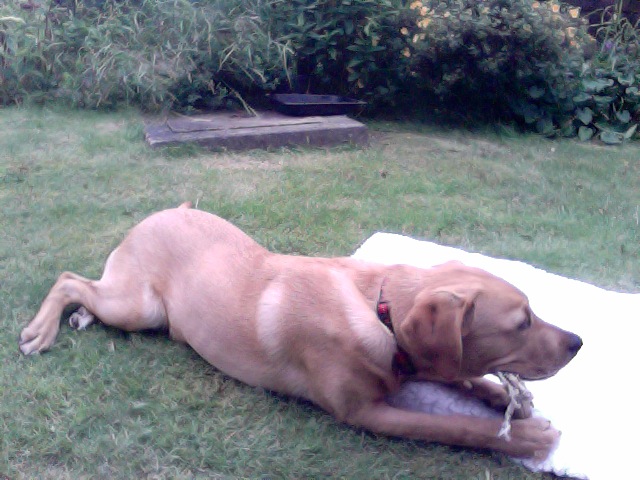
Currently, I have two halves of a novel and I’m not sure how I’ll make them into a whole. I’m taking a lot of long walks to think about it (in this picture,  I’ve just come back from a tramp in the rain around Willsbridge Mill with my ten year old daughter and eight month old labrador puppy). When I’m ready, I’ll pounce.

Manuscript: To Hide Her Blazing Heart

Word Count: 73, 419

A Little Bit About Working in Chaos

Image

Sorry that I haven’t written much lately. I’ve been waiting to catch up. Until I had just the right thing to say. Until my shelves looked nice for the photo. Until I lost just ten more pounds. Until…until things were okay, you know?

I’m sure you do.

I’ve done this before with my writing, too. I’ve waited until I settled down. I’ve waited because I want a nice room and I needed to paint the one I had. I’ve waited for a million different reasons. And then? I finally sat down in the mess and wrote.

Stephen King used to write on a typewriter on a board balanced across a lawn chair in the utility cubby of the trailer home where he lived with his wife and children. Jane Austen used to have to slide her ms. out of sight when callers came. Dickens could only afford to heat one room, and used to work in a corner while visitors and debt collectors came and went to talk to his wife.

I’ve learned that about fiction, but now I had to learn it about blogging. So, here I am. I need to lose ten pounds (well, actually thirty-two). I need to clean off my bookshelves. But I’m back. And I’ve written another 60,000 words.

Working Title: To Hide Her Blazing Heart

Word Count: 70,248

No Hindrance – Writing tips from a Zen master…

Twenty years ago. I am sitting on a cushion, opposite a Zen Master.

‘No hindrance,’ he says. ‘Don’t make good or make bad.’

‘But…’ I say. The day before I had told him that I had just remembered a horrible childhood memory, while I was sitting the morning four hours of meditation. Now, I want to ask him how I am supposed to live with the damage and pain I have just seen inside myself. I look at him, and he smiles at me. He pats my hand.

He says, ‘Don’t make bad. Just is.’

‘But…’ I start to say again. Quick as a flash, he whacks his stick on the table. It’s a big stick. The ‘crack!’ is so loud I can feel it in my sternum.

‘No hindrance,’ he says. I bow and leave. The interview is over.

Down I walk to the dharma room. I’ve been sitting uneasily on my cushion, ever since I remembered the horrible thing. I have found it hard to keep still. I’ve  been choking back tears. I enter the room as the bell rings for the next student to attend an interview. We pass each other at the door. I bow, and settle back down onto my cushion.

As soon as my breathing settles down, I start my practice. But again, I think about this horrible thing. Then, suddenly, I understand. I don’t have to think about it. I can just feel the pain and keep in the moment. I don’t have to go back and back and back to the horrible time. I can just stay here on my cushion and do my practice. That’s what I was here to do, after all.

I sit like a rock that afternoon. I acknowledged that this memory had come up. I felt the pain of it. But I was there to do my practice. It was no hindrance.

The Olympics are on, and you know I love watching world-class sport. I will have three job interviews this summer. My department has a new head and  new staff coming in. I still don’t have a publisher for Hospital High, and the puppy is being quite naughty. My daughter is off school and my husband has been home with a virus.

But I am here to write. And so I sit down and I wait for my breathing to settle and I travel into another person’s body, in another time and I put down one word after another.

No hindrance.  CRACK!

Project: To Hide Her Blazing Heart

Word Count: 10,357

You can find our more about where I got my Zen training here: http://www.kwanumzen.org/

On Leaping Over Obstacles

Image


I’m working in the garden of my in-laws’ house this morning. It’s nearly nine o’clock and I’m just about to stop and feed the family. Foyle, my puppy writing companion, has already been fed and is working on a rawhide bone while I write. He’s just done something admirable, which I’ll tell you about later – he’s not just my writing companion, he’s my writing guru.

I’ve been writing about an hour. It’s still going well. If I don’t stay up late again with my far-too-interesting inlaws tonight, I might get to write longer tomorrow. But as long as I write at least one hour, every single day, I know I’ll finish the book by the end of August.

Today, I realised just how flexible and wonderful my close third person, present tense voice is. I’ve never used a voice like it before and I love it for this novel. It makes everything right, everything that niggled before is now radiant and my prose is…well, it’s downright lovely. I’m so happy that I fear I’ll sound smug if I tell you any more…

I don’t sit down with a list of narrative techniques and decide how I’ll write a project – it doesn’t work that way. Sometimes something I am writing just doesn’t feel right. It will usually feel tight, as if my imagination was being constrained by the form.

Today, while I was writing, my in-laws’ longtime neighbour, Elaine, came walking by with her two dogs, returning from the field where Foyle and I had been earlier. Her dogs took exception to Foyle’s presence, and though Foyle put his paws up on the garden wall and leaned over to say hello, very friendly, they growled and snarled at him. Foyle and I went and sat down, but he’d evidently decided that this state of affairs was unsatisfactory, because, after sitting apparently contently for a moment, he suddenly got to his feet, ran to the stone wall and vaulted over it, landing briefly with all four paws on the top before dropping to the other side and taking off after those uppity dogs.

That’s what it feels like to get something right when you’re creating with words. One moment, you are unsatisfied with the way things have turned out. The next, you are flying over an obstacle you thought was insurmountable, chasing those problems away.


Working title: To Hide Her Blazing Heart

Word count: 6983

Your 10K

Image


Stop me if you’ve heard this before…

No, don’t stop me. I need to get in my 10,000 hours of blogging. Malcolm Gladwell, in his book Outliers, makes a convincing case that one of the key precursors to human success is 10,000 hours of practice. That’s the difference between a grade one and orchestral violinist – 10,000 hours of practice.

But every new task also needs that practice time. I can write; I am lucky enough to be able to write a wide variety of texts. But every new novel also needs, if not 10,000 hours, an awful lot of them. You can only find out how to write a novel by writing it. There’s no short cut. 

My latest revision is coming along beautifully. At last I’m truly happy with the narrative voice, which has been bothering me for two years. I think I’ve done enough practice now to do the real thing.

Word count: 5557

http://www.gladwell.com/


The Best

This is a post about starting over – about thinking to yourself, ‘no, that’s not good enough,’ and going on to get it right.

I have many role models in my life for this…lately Andy Murray, the British Tennis Champion. Murray is an extremely good tennis player. He’s been ranked in the top ten male singles players since 2007. He’s made it to the finals of all Grand Slam tournaments and once qualified for every final in the same year. But he hasn’t won a single one. Last year, he got a new coach, Ivan Lendl, and this year he nearly won Wimbledon. In his emotional thank you speech, he told his supportive fans that he is ‘getting closer’.

That’s what you need to be a champion – you need to want it badly. You need to be driven to do the best that you can, to be the very best that you can be.

And that means, when you’re writing something wonderful, you may need to start the whole thing over again.

My manuscript was coming along very well. I was storming ahead on writing it. But the voice wasn’t right. The pace wasn’t right. And even though the story is an amazing, breathtaking tale (I can say this, because I don’t feel like I made it up – I feel it was already there, waiting for me), it wasn’t being told as well as it could be.

And that’s not good enough. I’ve started it again, with a new voice. Because being really good isn’t good enough. Not for Andy Murray, and not for me.

Manuscript: To Hide Her Blazing Heart

Word Count: 1346


Writing – Making Space In Your Head

Here I am on the train to Portsmouth.

I’ve looked at perhaps half a million words of marking this week, and it’s only Wednesday. But I’ve also written four thousand words.

The writing is going well.

Why this week, and not the week before last? I was just as busy then, but the idea of opening up my manuscript and working on it was… ridiculous, ludicrous, laughable – take your pick. Utterly unthinkable.

But why? I’ll look at and evaluate some million words of student work this week. Brunel for Monday, Portsmouth for Wednesday, Derby for Friday. I’m working nearly around the clock on Sunday, Tuesday and Thursday, and travelling at least three hours every other day, still looking at work on the train. It’s more work than I marked in the weeks before. It’s bigger, tenser meetings with people I don’t know and who don’t know me.

But the writing is going well.

I think it’s because it doesn’t really matter what you do for the rest of your day; it’s how much of yourself you invest there. I’m naturally keen that I accurately judge the processes of my colleagues at other universities; I’m not slacking on my work as an external. But it’s not as draining as trying to help hundreds of students achieve their best work.

Teaching, if you do it right, is fulfilling and exhilarating and wildly exciting. But it’s also draining. It takes up lots and lots of space in your head. There are all those young faces, looking at you, hoping you will help them to learn something about which they care desperately.  Those young faces get in the way of the other people in my life, the characters in my books. Two weeks ago, they made it hard to see the little huddle of people in my abbey; the people that are, in the midst of terrible challenges, trying to make a life for themselves and their children.

Now that fewer people call me back to the real world, I am able to spend more time in theirs. I have space in my head, and they move back in. That’s where they live, and act out the story I will tell.

Current manuscript: To Hide My Blazing Heart

Stage: Complete Rewrite 1

Word Count: 11,290

It’s Your Ball

Image

Image

We’re watching the Euros in our house. That’s the  European Cup Football Finals, and when I mean football, I mean proper football – soccer.

It’s a bit of dull game, Germany v Portugal, so I’m writing this post while I watch the second half, even though I’ve been looking forward to the match all day.

What it is about writers and sports? Many of the writers I know (and I know loads) are passionate about one sport or another. A well-known YA author I know loves dressage. A TS Eliot Prize-shortlisted poet watches rugby. A great nature writer loves international cricket.

It’s all about international football for me, now, but my first love was baseball. I just read a wonderful novel, The Art of Fielding by Chad Harbach, and it was an amazing book… a world made of words that postively reeked of Deep Heat and sweaty socks. It was written by someone who knew about sports, knew deeply about how sport works; the self-sacrifice, the accommodation every sportsperson must make with terror and pain, the elevated moment when everything depends on you and everyone is watching and it goes wrong or it goes right.

And maybe that’s really why writers love sport. Because we, too, are making our mistakes and having our successes in front of other people. We may think we’re sitting alone in our rooms, but on some level (and much more obviously so once we start publishing) we’re really performing for spectators.

Just like every game is different, every piece of writing is, as well. You can only develop your skills, work hard, hoping that you can manage the technical challenges it will bring. Hemingway saw it as a boxing match or a fishing expedition. I still see it as a green diamond of grass, and a white ball coming down to my glove.

I want to catch it for me. I want to catch it for my readers. And I want to catch it to show all the spectators that I can.

But Gomez has just scored and one of my favourite players, Schweinsteiger, is playing like a dream. I’m going to watch some more; watch how other people do, watch them as they play…as they risk failure in front of other people. Watch them fall down and get up again, watch them sweat and cry and exult.

It makes me feel less alone.