Other Writers I: Writing Friends

me n dots focus

When we’ve finished a piece of writing, there’s only one thing we want to know. Is it any good? 

When you’re beginning, and sometimes far into your writing career, you often can’t tell by yourself. You’ve looked at a given piece of writing so long, and have written it over and over. Sometimes you just can’t see it any more.

If you give it to your mother, or your best mate or your sweetheart, they’ll tell you how wonderful it is, and how wonderful you are. But that’s not what you needed to know. You needed to know, is it any good? And they can’t tell you.

Usually they can’t tell you because they don’t know all that much about great writing. But sometimes they can’t tell you because they know too much about great writing, but not a whole lot about how writing and writers develop. And sometimes they can’t tell you because your whole relationship is in the way.

This is where other writers come in handy.

Writing groups are not a new phenomenon. Think about the Romantics…the Lake poets, brother and sister Wordsworths, Coleridge, Southey, de Quincy. Think about the Beats…Ginsberg, Kerouac, Burroughs, Snyder, Corso. Think about what Dorothy Wordsworth did in terms of editing and encouraging other people’s work. Think about Lawrence Ferlinghetti, the great Beat poet, and publisher. Dorothy and Lawrence wrote themselves, of course, but they were also great enablers of writing…we owe some of the best work of the last century to the energy and vision they brought to their writing groups.

I met with my own writing group two nights ago. I don’t go as often as I need to. I don’t participate as much as I’d like. Sometimes I can’t read everyone’s manuscripts. Sometimes I don’t submit my own writing early enough or at all. But although manuscript critique is important, in the end the place to talk about your writing can be even more important.

What happens, when writers get together to enable each other’s writing is an explosion of creativity. No one knows this better than Susan Tiberghien, author of One Year to a Writing Life. The group she’s gathered in Geneva, Switzerland fizzes with energy, and they give each other incredible support. Clubbing together, they are able to bring in writers from all over Europe to help and inform them. Like my own writer’s group, the members write many different styles and genres…and are achieving a remarkable publication rate.

The best academic writing programmes do this, too. At my university, twenty years ago, three English academics showed each other their own writing. Finally, they decided to offer a creative writing module in the English degree. Now, there’s a BA, three MAs and a PhD programme. There are over 400 students on two campuses, engaging with writing, and out of the MAs have come literally dozens of prize-winning poets, novelists and children’s authors.

One writer plus one writer does not equal two people writing. It does something else. The writing gets cleaner, the energy gets stronger. They take more risks. They work harder. They get…well…better.

What Feeds Us

Photo on 2014-02-02 at 10.04


Well, I”m pretty tired. It’s been a manic marathon of talks, workshops, chat, contacts, advice (given and received) and inspiration (ditto). I’ve loved the Geneva Writers Conference. If you ever have a chance to go, do.

One of the things I’ve most enjoyed is my classroom. Although I don’t do much nature writing, I need natural beauty to write. It feeds me, somehow. When I get stuck, I go for a long walk or a drive in the country and I can almost feel myself filling up with joy.

Ages ago, my friend, the photographer Tracy Piper Wright (http://tracypiperwright.co.uk/) and I left London to begin following our artistic careers. We thought we’d be back in town all the time, to meet up, to shop, etc. Actually, we stayed out of town for ages.

Finally, she began going back regularly, for gallery shows. ‘You can’t sh*t,’ she said, ‘if you don’t eat.’

She’s much more elegant in her conversation now, but she was right. You have to feed yourself…feed yourself whatever nourishes you. For me, today, it’s the energy of my students, but also the way the afternoon light makes the cedar trees glow like turquoise neon, and the distant sparkle of the lake.


The Big Secret of Teaching

Photo on 2014-02-02 at 10.04


A mate just got a big book deal. ‘Oh,’ someone said. ‘Does that mean you can give up teaching?’

She looked horrified. ‘No, ‘she said. ‘It means I can give up worrying.’

Why would we want to give up teaching? Well, there are reasons, mainly connected to worrying…you might worry about not being retained by your institution, worry that you’re working too much to write, worry that you won’t be able to help your students as much as you’d like.

But the teaching itself is…well, it’s just jam for writers.  The Big Secret is that we learn much more from teaching you than you do from us.

Everything I say to you, I need to remember or relearn myself. Everything you write, inspires me or reminds me of how far I’ve come with my craft skills. The energy in the room of silent scribblers (which I talked about yesterday) is absolutely wonderful, a refreshing, enabling cocktail of concentration and effort that I absorb without doing a single thing but sit.

My students often come up to me and thank me.  I let them.

I’m good at keeping secrets.

The Energy In The Room

Photo on 2014-02-01 at 14.58

Writing. We make it into such a big deal, don’t we?

You sit down. You pick up a pen or put your fingers on the keyboard. You write.

Or… you don’t.

When you start a project, the energy of creation carries you through the first draft. Or much of it. Or a whole bunch of it. But the first draft is nothing. It’s the fifth that kills you. Then the sixth is a bit easier because now you know what you’re doing. The seventh is a breeze.

So, how do you get through two, three and four? In any long writing project, there will come a time when you loathe the sight of your own office wall. You hate your project. You hate yourself for writing it in the first place and you hate everyone connected with you writing it for any longer.

The energy in the writing place drops, and you feel the will to live leave your body each time you open the file.

That’s normal.

There are all kinds  of ways to get around it. Shortening your working time and making it more regular. Setting goals with rewards. Having your agent call you in a panic every day to see, ‘how you’re getting on’.

But one of the best ways is to write with other people.

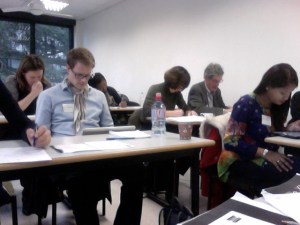
Look at the photo above. The energy in the room was electric. If you get some friends in the same state and you all get in the room and open your files and stare at them together, something magical happens.

You all start to write.

Or you don’t, and go out for coffee instead. Either way, it’s good.

Hey, if it was easy, everybody would do it…

About Place

Photo on 2014-02-01 at 09.14 #2


Here I am, in my classroom at Webster University, in Geneva. It’s a beautiful, fresh day in this part of Switzerland. Its the first day I can actually see the tops of the Alps.

I can’t think of a better place to teach Writing About Place, which I’m doing as part of the Geneva Writer’s Conference.

I’m rather passionate about this subject. When I was at university, the Deconstructionists were just coming into the study of English Literature. I used to run away, escaping to the Geography department and do modules in Human Geography. Which is how I accidentally ended up with a minor in geography.

But I don’t think I’m passionate about place because I did geography. I think I did geography because I was passionate about place. Because I was a writer.

Before you write, you need to be able to notice. Writers notice things and then write about them for other people. If you don’t notice things, you don’t have anything to write about. But sometimes it’s hard to write about environment, about the culture of a place, about the economy of a place – when you know it so well that you don’t notice  it any more.

There’s a reason why Joyce and Hemingway and Fitzgerald wrote better about home in Paris than they did at home. There’s a reason why great writers often set their work far away. It’s much easier to see something when you are seeing it fresh.

Your setting is not just how pretty the trees look when they’re in blossom. Your setting is why the old women wear black. Your setting is who is up and working already by eight in the morning and why. Your setting is who is in charge and how things are for your character, their family and their community.

Look again at your world, at the amazing  complexity of it. Notice it again. And let it breathe and grow and struggle on your page.

Reading for Writers

Image

A little while ago, I talked about how revealing it is to write. It’s true…you can’t hide when you are writing. What and how well you think, what and how well you feel – it’s all there, all over the pages. 

And what’s also visible is how much and what you’ve read.

Every author I know would rather read than breathe, if they were only given a choice. I read, I recently told a third year class, about a novel a day, or two or three days. And that’s with my busy life as a writer, teacher and mother. When I was their age, I usually read one in the morning before classes and one in the evening. They looked at me as though I’d suddenly sprouted antennae. 

I read very quickly, but I have excellent retention. Sometimes I forget the name of the author, or the title of the book, but I remember the characters, the setting, the plot and whole segments of text.

And that latter bit is very important. Every time we read, we are unconsciously absorbing technique. We see how the author handles the technical challenges of fiction. We’re not only enjoying the story and the beauty of the writing…we’re building a library of technique. 

Some of my undergraduate students worry about writing too much like the authors they read. In fact, some of them use it as an excuse not to read. But the answer to that is to read more, not less.

The more widely you read, the more and different approaches to the technical challenges of writing fiction you absorb. How Jane Austen uses punctuation is much different to how William Burroughs uses punctuation and you never know when the perfect solution to where you put that tricky comma will come from one or the other. 

But of course the real value of reading widely comes from that connection between reading fiction and empathy. The more you read, the more empathy you can feel about different kinds of people. Young women, pressured to marry if they are to avoid poverty, for example. Or a junky trying to survive in a menacing and unknowable world. 

And that means the you that is revealed in your writing is a better you, with every book you read. 


More On Why We Write

Photo on 2013-12-05 at 10.38

I’ve been working on my fictionalised account of dying in a car accident. It wiped me out yesterday, writing about dying again. I felt sick and shaky and in describing my PTSD, I nearly started it up again. I had a few flashbacks, but then had a cup of tea and a chocolate biscuit and they stopped. It must be good, I thought, to be that powerful. I took Dog for a walk just to be on the safe side.

While I was walking Dog, I ran into a lady from church and Dog played with her dog while we chatted. I said something about my day and she said, ‘That must be very cathartic, writing it all down like that. You must feel soooo much better.’

Well no, I didn’t answer. I feel a whole lot worse, actually.

I  know writing can be therapeutic, but it can also be destructive. Obsessively looking and reliving any event can be less than useful to building a healthy psychology. And writers are often sickly people anyway. They start noticing things because they are sitting quietly, out of the way. They have time to write because they didn’t get chosen for the hockey squad, or (like a surprising number of our MA students) got injured by horses, or have a kind of shyness that almost amounts to an injury. We are, generally, just the kind of people who need to get out more in the fresh air and worry less.

Shelley’s idea that we are ‘the unacknowledged legislators of the world’ might also be true, in a way, but we legislate for lots of different parties. In my bookshelf, Jane Austen sits next to William Burroughs (it’s not that I don’t have any Balzac, etc, I just roughly alphabetise and there’s room for both of them on that particular shelf). I worry about it all the time. I know they’re not getting along. Depending on what you think is right and wrong in this world, you will find great authors who are actively promoting what you think is wrong. Writing does not tell us how to live…if we are looking for it to do that, we have gone seriously astray. If we think we are supposed to do that for other people, we will be very disappointed.

Both of these concepts take the emphasis actually away from the writing and put it on what the writing is about. But what the writing is about isn’t nearly as important as how the writing is. When we read creative writing, we are able to inhabit the sensibilities of another person – the writer- who, themselves, might be writing in a way that they, too, are attempting to inhabit the sensibilities of another person. The writing itself, the how-good-is-it-ness of the writing, enables us to do this spectacular thing; bridge out of our own consciousness.

When people ask me why I write, I always say, ‘To serve God.’ That’s me, as a Catholic, as someone who promises every morning that ‘each word, each deed, each thought of mine shall be an act of love divine’, and every evening acknowledges my failure to accomplish the morning’s promise. I don’t mean that I’m writing religious tracts. I mean that I’m writing as well as I can, to make these bridges.

It’s great work. Sometimes it’s even rewarded.

But that’s another post.

http://www.theguardian.com/books/booksblog/2013/oct/08/literary-fiction-improves-empathy-study

Riding the Just-broke Horse

Photo on 2013-11-29 at 11.49 #5

I’m waiting.

I had a phone call with Editor O’ My Dreams this week and we talked about what she wants from the beginning of my fictionalised-memoir-of-dying-in-a-car-accident. What she’s asked  is going to be quite challenging. She wanted the fiction to show more than the memoir about my life before the accident, about what I lost when I lost my voice. But now that she has that, she misses the immediate sympathy and hook of the original beginning, which took you just to the moment when I was struggling to stay alive. Somehow, I now have to weave both into the beginning.

I tried to work on it yesterday, but my imagination wouldn’t come when I called.

It’s like that.

And I really wouldn’t want it any other way.

One of my first jobs was as a cowgirl. Well, I could ride and we’d all had to leave the ski hill where I was working early because the snow just…stopped. In Montana. In January. It wasn’t like there were tons of jobs waiting for us. I could string fence and I could ride and I knew how to move cows around. I have no idea how I knew how to move cows around. I’d never done it before. But on my trial, I motivated them through a gate as if I’d been born doing it. The rancher ‘s wife was impressed and I was hired.

I also got involved with training horses (and, later, mules, but that’s another story). I was working as a waitress in an all-night diner on the graveyard shift and feeding cattle and riding fence in the early mornings. I slept from mid-morning to mid-afternoon, but then I had some free time. I was also usually still wearing my jeans and boots, having collapsed on top of the quilt. I thought I might as well make some extra money, so I took on the training.

Some of the horses were just-broke. You could get them to come to you, eventually, and you could get the saddle on, usually. What happened when you got into the saddle was not predictable.  There was only one thing about them of which I was certain. They loved to run.

They were still young. They could still remember the freedom of the big fields and ranging the mare/foal pastures. They couldn’t wait to shake the fidgets out of their legs. I stopped riding not long after that time, after a bad fall which dislocated both arms and my nerve. But back then, I was still totally fearless with ten or twelve years of riding under my belt. I’d raise up a bit in the stirrups (I’ve always liked them a bit short), lay down on their necks and just fly.

The mountains were high and snowcapped. The air was angel-pure and burned your lungs with cold. It was, I suppose, about as close to heaven as we mortals get.

And that’s just what it’s like when the writing comes. I lose track of my fingers and what they’re doing. I forget that I’m making a world with pixels on a screen. I just fly.

But first, I have to catch the horse. It will come to me, eventually. And I’ll be able to get the saddle on, usually. But sometimes I can’t and sometimes it won’t come when I call.

It’s like that.

What Do You Do To Be Creative?

http://www.youtube.com/watch?v=Tsmmr8693wo&feature=youtu.be

I was asked by a colleague to make a short film answering the above question. It might be a mistake to have answered it and I’m pretty sure I shouldn’t post it here, but I don’t want to waste my efforts…

On Being Irrepressible

Photo on 2013-11-18 at 07.54 #2

I’m going to talk about writing. I’m going to say something very profound and important. But first I’m going to talk about my hair.

My hair. Sigh.

Some of you have always known me with straight white-blond hair. The fact is, I thought I’d bleach it white and that made it straight (I also made it break and made my scalp bleed a little, too, but hey, ho). I couldn’t keep doing that (even though I loved how it looked) so I’ve had to go back more to my original colour. And my curls are starting to boing up. Straightening them takes me half the day. Cutting them off seems to be the better option. There’s just no stopping my hair, once it starts.

And, now that I’ve given myself permission to start writing again, there’s no stopping that, either. I’m still waiting for the Editor O’ My Dreams to come back to me. I delivered two new manuscripts to my agent last week (well, one new, one rewritten after her comments) and, over the weekend, I started another, which will be a follow-on to the based-on-a-true-story ms with the Editor O’ My Dreams.

And something else seems to be happening, too. I’ve always read every book I started. All my life. Some, like James Joyce’s Ulysses (which I read far too young) I threatened to leave, but I didn’t. Every crappy romance found on a rainy day at a B&B, every sports biography opened during a sleepless night at a relative’s house, every Rainbow Magic Fairy book my daughter pressed into my unwilling hands – I read them all to the last horrible page.

Now, I’m not. I’m saying to myself, ‘That’s too self-indulgent. I’m not reading any further.’ Snap shut the cover. I’m saying, ‘This is too densely referential and all the research is ruining it for me.’ Regretfully pat and put back into library bag.

I’m not reading anything else that I don’t like. Even if the writer won the Nobel.

The fact is, when I became  a professional writer, I started listening to what people told me about writing. About mine, about other people’s… I rather lost my own sense of taste, my own understanding of what is good and what is not. I’ve got no beef with Louise Rennison – she’s dead funny. But I’ve had the fiction director of my publishing house sit down with me and ask me if I thought I could write more like her.  And felt bad because I didn’t think I could ever say yes.

Well, goodbye to all that. Life is too short to read books you don’t like…and much too short to write them.

I’m afraid my taste in writing, like my hair, is becoming, once again, completely irrepressible. My hair colour might change again. But that won’t.