It’s Never Too Late

Image

I usually write this much earlier in the day and with cleaner hands.

It’s ten minutes to eleven (pm) and I’ve just finished doing a few things to the front garden by the light of the street lamp and the picture window. Foyle ‘helped’, the rest of the family are asleep.

One of the things I did was replant the big ornamental pot. I put in a small fuchsia bush, two night-scented stocks and some thrift (there was a great sale today at a local nursery). I had to wrestle out an old dwarf conifer and some heather. They’re wrapped up in some plastic to be sorted out tomorrow.

You might think it’s a bit late for gardening. Well, I don’t have much time these days, and I felt like it needed doing. I wasn’t sleepy yet (I am now), so I thought I might as well go ahead and sort it out.

I got a few funny looks from the teenagers who usually have the streets to themselves at this time…but it’s good for them to be disturbed occasionally.

Lots of people want to start doing something new, but they think it’s too late. We get them all the time on the MA in Creative Writing…and it can really mess up their writing if they think they must be published before they turn 35, or 50 or 70. We tell them it’s utter nonsense. It’s much more important to do the best you can, when you can, than to do it rushed or not to do it at all.

A friend of mine was considering doing a law degree in her late 30s. ‘But  there’s no point,’ she said, ‘I’ll be nearly 50 by the time I can practice!’ My husband asked her, ‘And how old will you be if you don’t do it?’

And that’s the thing to think about, isn’t it? I’d still have been awake until eleven if I’d sat on my bum and watched telly with a glass of wine. Instead, I’ve been sipping on a glass every time I pass the kitchen counter, as i’ve been in and out of the house and up and down the path.

Tomorrow, I’ll look at the old conifer and heather and think about if I can still use them somewhere. And that happens, too, in a life change…you might put something aside for awhile and then come back to it again. My husband worked hard to become a teacher, and then went back to the wine trade, where he’s very happy and successful. A few of our MA students every year decide that they don’t want to be writers after all. I think that’s a very good use of the tuition money and a year of their lives; they don’t have to think they’re in the wrong job anymore. They don’t have to wonder if they’re squandering their talent.

I suppose what I’m trying to say in this post is that life is short, and that we should go ahead and try things. We might get a few funny looks, now and again, but there’s really no substitute for exuberant experience. Ask yourself Andy’s question if you feel too old to follow your heart: How old will you feel if you don’t????
Knowing Your Breed

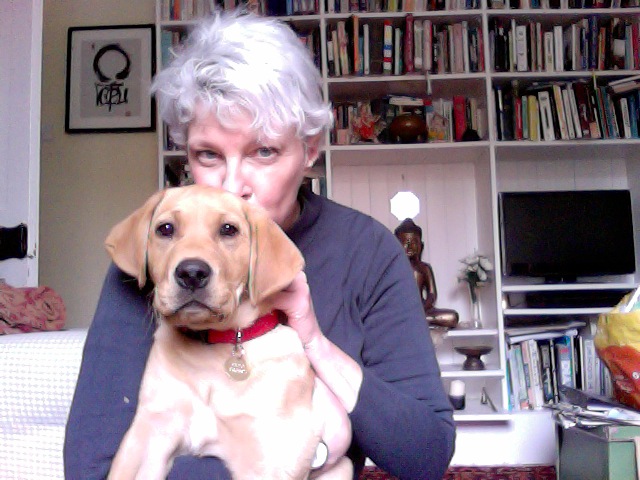
I’ve just been for a walk with Foyle, our 3 month old Labrador Puppy. It was our first walk to the other side of the river, where we met a lovely West Highland Terrier named Sam. He and Foyle were playing happily and Sam’s owner and I were chatting when another pair of Westies arrived and were let off the lead to join the game. Then another arrived and its owner smiled and undid the lead on its leash. There was my golden lab puppy, suddenly surrounded by a sea of white West Highland Terriers. One of the Westies hated puppies, and though Foyle laid down and showed his tummy, it kept lunging at him until he cowered at my legs. I actually had to lift Foyle away from his tiny little teeth.

As we walked away, waving to the nice doggies with the nice owners (and inwardly cursing the nasty one), Foyle saw two labradors on the other side of the river and heaved a tremendous sigh. He’d spent Monday with his mother, grandmother and two siblings and he clearly missed hanging out with his own breed.

Knowing your own breed is important for writers, too. It’s important to know who you are and how that relates to your writing. Not so much because it helps your writing process, but because it helps you, as a writer, to establish yourself, to talk about your work intelligently and to communicate the worth of what you are writing to other people.

Even after seven books, I’m still not good at this. I’m still not sure I’ve found my breed…and I’m not the only one. I was talking to a mate the other day – another successful writer. She was saying that she doesn’t frame the discourse of her work properly; that she thinks she misses out on things because she doesn’t talk about her work in a way that allows other people to see who she is and where she fits.

I want to know, like Foyle, when I’ve been bitten because I’m playing with the wrong bunch. I want to know what I’m going to look like, when I grow up. I want to know my breed.

Adventures In Data Loss


It’s not easy, sitting still and not looking while a nine-year-old paints your face. She’s not overly careful around the eye area and she tends to drip a bit… You have to just breathe out, close your eyes and enjoy the ride.

I’m not one of those Americans that thinks ‘it’s all good.’ I think the relentless positivism we’ve been asked to assume over the past few decades is actually harmful. Cancer patients that don’t get better can feel they’ve not been thinking the right way, or praying hard enough…people can be exploited and not have the language in which to express anger with the conditions in which they work… However, I don’t think there’s any point in being miserable, either. Sometimes you just can’t control things, or you let things slip out of your control.

I have a whole little lecture I give about data storage, about how to save daily iterations of your novel and how to back it up weekly both on a data key and by emailing the files to yourself. But, like anyone else, when I get terribly busy, I sometimes get lax. This week I lost 5,ooo words of my new book.

It happens.

It happened before computers. Hemingway’s wife was bringing his stories to him, as a nice surprise, when she left them on the train. Hemingway was still mourning those stories, some twenty years later, as the best things he’d written.

But I’m not so sure. My 5K took me through some very difficult technical things; another shift in time for the entire main section of the novel… a shift in my narrator’s voice, as she recalls things from two years earlier…an explanation as to how and why her community lives the way it does…  I’m dreading trying to write it again. It might very well be worse. But it might be better, too.

And anyway, I didn’t sign up to this kind of life with the idea that I would have everything under my own control. I became a writer, much like I sat down for my face painting, in a spirit of adventure.  I think my face turned out fine, for an evening at home making pizza. I think my writing life is more interesting and exciting than if I’d kept doing jobs I didn’t like. Hang on, we’re still moving, and who knows where we’ll go…

Here’s a soundtrack for the blog, since it’s Friday night. Click to hear it. Hope you like it…


For more about positivism and the harm it can do, read Barbara Ehrenreich’s Brightsided. 


Why Write?


Why do we do it?

No, I’m serious, here. Why write full length fiction?

The drawbacks are immense… Unless you are very fortunate you will be underpaid and have to balance your writing life with another professional life, so you are working two jobs. Your entire life revolves around making things with words…so when you sleep/what you eat/what you drink etc., are all governed by your writing time. Your family must either be trained or escaped, and it puts a strain on all relationships…it takes very understanding friends to know that when you disappear for months on end, you still care for them but are only on a roll.  And then, at the end of all that, two words from a publisher or reviewer can make you feel it’s all been a waste of time and effort.

Life is a whole lot easier if you don’t write books.

Last week, I ran my ‘big ideas’ workshop for the redoubtable Alex and Jude’s Writing Events Bath. And as we talked about what a novel actually was, I felt the whole room’s desire to make one themselves. That desire hasn’t gone away in me, either. If anything, it’s gotten stronger with all the years and ups and downs.

Why write? Because you have to. Because you can’t stop. Because it’s the whole point of life.


Too Busy For Words


Hi. How are you? Miss talking to you.

Book’s going okay. Shared it with my workshop group. Got some good feedback. Feel a lot more confident.

Still got 40K marking/second marking to do. House is filthy. Friend from Prague still with us, bless him. Going to Chicago soon and taking daughter. Got meetings almost every night this week and a todo list as long as my inseam.

Real busy. Crazy busy. Insanely, stupidly busy.

But I’m writing. Some days not showering (see side of hair, above). But writing.

I mean, we’re all here to do something, right? And that’s what I’m here to do. So I’m doing it. Hope you’re doing what you’re here to do, too.

Look, I gotta go. We must have a proper chat soon. I’ll ping you.

Big hug. Big kiss.

Mimi


Into the Wild

Image

A new year. Here, it’s a gale-force rain storm. I’d thought about writing in a local cafe today, but, after venturing forth to take my daughter’s huge homework project to school, ended up back on my bed.

As a family, our new year resolution is to get outside our comfort zone. Even our priest used those words in his New Year’s homily, urging us to become more saintly. Get out of your comfort zone. We seem to be hearing it everywhere.

There’s nothing comfortable about trying to write as well as you can. It doesn’t matter if I’m on my bed, on a  train, or in a car on the Palestine/Israel border (where I once wrote a very good poem)…I’m still taking risks.

A narrative is very revealing. It shows the limitations of your thoughts and your courage. It allows others to see the limitations of your character, of your very self.

And that’s only if you’ve done it WELL. If you’ve made a mess of it, it’s excruciatingly embarrassing.

Too, as Annie Dillard says, when you leave a manuscript alone for too long, it grows feral and wild. You have to ‘hack your way back into it.’

I have left my heroine like Sleeping Beauty; all alone in a tower over Christmas. Now, I’m going into the jungly brambles, to hack my way back to her. Yes, I’m working in bed. AGAIN. But it’s not exactly comfortable.

I wish you all the best fortune in the New Year. May it bring you happiness, wealth and lots and lots of discomfort.

Working Hard


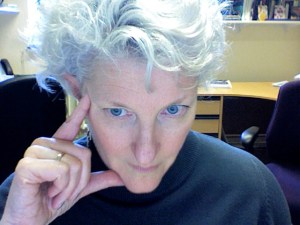
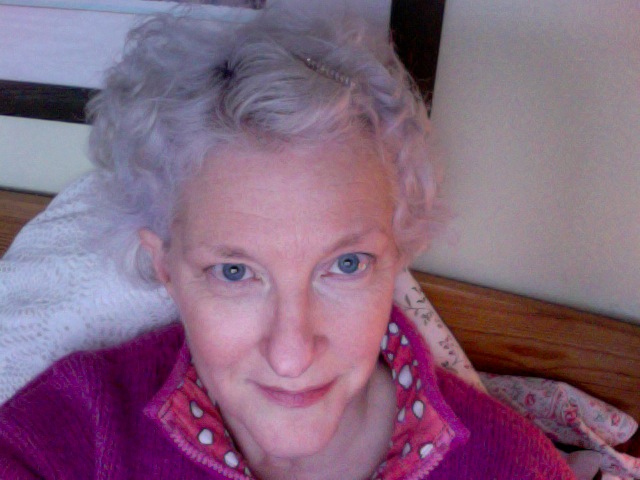
Here I am, hard at work. I know it doesn’t look like work. My work very seldom does.

I lay in bed,  my computer propped up on my knees, and write. Today, I’m writing about my narrator remembering something; a horrible memory of a time when her small community was starving and suffering from dysentery. I’m all cosy in bed and thinking about what I’ll eat for breakfast at 10:30. She’s haunted by the memory of trying to feed a dead person. I’m getting up soon…I can’t write this book for too long at a stretch.

I’ve been up once. I’ve made a party plate for my daughter to take to school, helped her style her hair, said goodbye to my husband and waved my daughter off to school on the taxi she shares with six other children. I’m sure, as I’m waving goodbye in my dressing gown, everyone in the street thinks I’m a terribly lazy mum. But I was working before six a.m.

At some point today, I may read a book or watch a film. That’s my work, too. I need to keep up with the narratives other people build. I need to have some concept of the context in which I work.  So, lying in bed and typing is work. Lying on the sofa and reading a novel is work. Sitting in the cineplex, watching a matinee is work.  Sitting on a plastic bag, watching the river rise in the rain; that’s work, too.

Sometimes (in fact, surprisingly often)  I even get paid.

Losing Everything…Except the Plot

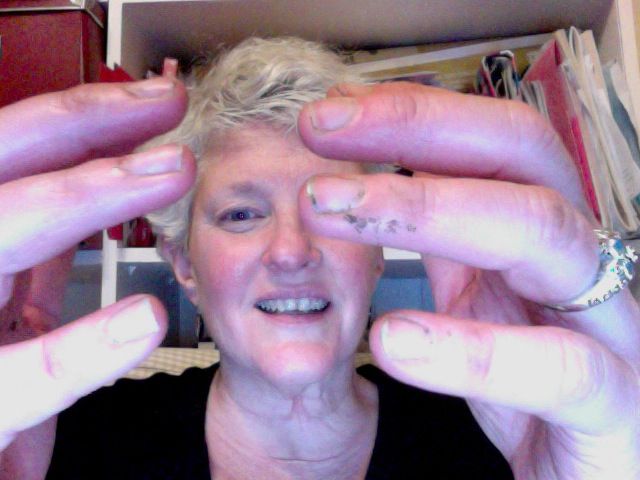
I don’t know where my house keys are. I’ve lost the pin number for the card I need to pay my hairdresser. I messed up my own haircolour (see above) and also need the pin number so I can go to the chemist/pharmacy and buy more stuff to sort it out. It’d be nice to be able to lock the door when I do that…I went to the hairdresser with it unlocked.

I don’t even want to talk about work – I think I’m on top of everything, but I have a nasty feeling that’s a fairy tale I’m telling myself.

But the new book is going great.

I need to call Sophie to make sure she got Hospital High. I need to write this blog. I need to clean my kitchen and my bathroom and sort out a hundred other things. And Christmas is coming (aaaargh!) and I’m sure I’m late to post my lovely mommy’s presents again.

But the new book is going great.

And as usual, there’s a correlation between those things. I could be a much better mum, friend, teacher, co-worker, wife, housekeeper, etc, if I actually used the whole of my brain. But I don’t. Oh, yes, part of me is trying to do her best for everyone. But part of me is in another world entirely, with a whole other set of people. Part of me is working out just how I’m going to introduce various plot strands into the complicated structure and voice of this novel. Part of me is in a tower today, scratching a letter to the bishop on homemade paper with a rusty pen.

People who value my writing understand. And people who don’t   …well…    I say the words, ‘I’m sorry,’ an awful, awful lot…

Hurry Up and Wait

Well, it’s gone! Huzzah!

I was right that it wouldn’t take long to finish Hospital High once I knew what I was writing about…I sent it off to Sophie just now.

Now, I’ll do what authors learn to do best – I’ll wait.

First I’ll wait for Sophie to have time to read it. Then I’ll wait for her to send it out. Then I’ll wait for editors to come back to Sophie.

I hope I don’t have to wait too long!

In the meantime, I have my new book. I can’t wait to get started on it again. And after that, my bear book. So it’s not like I’ll just be filing my nails and watching daytime television…

But right now, I’m going to treat myself to a giant cup of tea and a bus ride to the garage to pick up my car. It’s going to be wonderful driving WITH a clutch.

Hope Sophie can help me pay for the repairs. I wonder how long it will take her to read it? I wonder how long it will take to sell? I wonder if I’ll get a good deal for it? I wonder …

Hey, I said we learn to wait. I didn’t say I already knew how…

What’s Your Book About???

I ask my MA in Creative Writing students to come up with an ‘elevator pitch’ for their novels. ‘Tell us, in a few words,’ I say, ‘what your book is about.’ The problem is, of course, that a lot of them don’t know.

They might know they don’t know or they might think they know. But they really don’t. You don’t know what a book is about until you’ve written the first draft. And sometimes you don’t know even after it’s been published.

Take the amazing story my PhD student, Louise Johncox, is writing about her family’s teashop. Her family come from Poschiavo, in Switzerland (click here for a live web cam of the village), and have been patisserie chefs for literally hundreds of years. For the last one hundred years, they’ve run teashops in Britain, where they’ve made cakes, pies and their own chocolates. Louise’s generation did not continue the family tradition. It  all ended with Louise and her siblings. When she started to write her book, she thought that was the story. But the real story was about conserving the family recipes, many of which were only in her ailing father’s mind, and about coming to terms with the inevitable loss of her handsome, talented, dynamic, larger-than-life father in the only way journalist Louise could…by writing him into immortality.

So this week, I’ve discovered what Hospital High is really about. It was obvious, actually. I’m surprised I didn’t see it in the first place. I think I was just too close to the story to notice that it needed to be explained.

I wanted to be a singer when I was younger. It was everything to me. And I was good. When I died in the car accident, one aspect of me, the singer, never came back. But I learned to sing with paper and pen, instead. Obvious, really, especially when you consider that for the majority of the years covered in the memoir I couldn’t speak at all, but could only write in order to communicate. But I managed to overlook that element. I left it out altogether.

Now, I’m charging ahead on the manuscript, making all this clear. I have that heady, heedless feeling that only comes at the end, when you know where the manuscript is going and you don’t really care if the house burns down, as long as you can sit somewhere warm and comfortable and keep writing, perhaps a cozy place by a burning rafter… For the first time, I think I might actually be done with this book, if not this Thursday, than surely by the next. And I mean it this time, because this time I know what I’m doing.