The Big Secret of Teaching

Photo on 2014-02-02 at 10.04


A mate just got a big book deal. ‘Oh,’ someone said. ‘Does that mean you can give up teaching?’

She looked horrified. ‘No, ‘she said. ‘It means I can give up worrying.’

Why would we want to give up teaching? Well, there are reasons, mainly connected to worrying…you might worry about not being retained by your institution, worry that you’re working too much to write, worry that you won’t be able to help your students as much as you’d like.

But the teaching itself is…well, it’s just jam for writers.  The Big Secret is that we learn much more from teaching you than you do from us.

Everything I say to you, I need to remember or relearn myself. Everything you write, inspires me or reminds me of how far I’ve come with my craft skills. The energy in the room of silent scribblers (which I talked about yesterday) is absolutely wonderful, a refreshing, enabling cocktail of concentration and effort that I absorb without doing a single thing but sit.

My students often come up to me and thank me.  I let them.

I’m good at keeping secrets.

The Energy In The Room

Photo on 2014-02-01 at 14.58

Writing. We make it into such a big deal, don’t we?

You sit down. You pick up a pen or put your fingers on the keyboard. You write.

Or… you don’t.

When you start a project, the energy of creation carries you through the first draft. Or much of it. Or a whole bunch of it. But the first draft is nothing. It’s the fifth that kills you. Then the sixth is a bit easier because now you know what you’re doing. The seventh is a breeze.

So, how do you get through two, three and four? In any long writing project, there will come a time when you loathe the sight of your own office wall. You hate your project. You hate yourself for writing it in the first place and you hate everyone connected with you writing it for any longer.

The energy in the writing place drops, and you feel the will to live leave your body each time you open the file.

That’s normal.

There are all kinds  of ways to get around it. Shortening your working time and making it more regular. Setting goals with rewards. Having your agent call you in a panic every day to see, ‘how you’re getting on’.

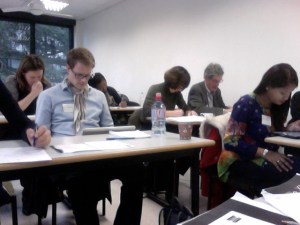
But one of the best ways is to write with other people.

Look at the photo above. The energy in the room was electric. If you get some friends in the same state and you all get in the room and open your files and stare at them together, something magical happens.

You all start to write.

Or you don’t, and go out for coffee instead. Either way, it’s good.

Hey, if it was easy, everybody would do it…

About Place

Photo on 2014-02-01 at 09.14 #2


Here I am, in my classroom at Webster University, in Geneva. It’s a beautiful, fresh day in this part of Switzerland. Its the first day I can actually see the tops of the Alps.

I can’t think of a better place to teach Writing About Place, which I’m doing as part of the Geneva Writer’s Conference.

I’m rather passionate about this subject. When I was at university, the Deconstructionists were just coming into the study of English Literature. I used to run away, escaping to the Geography department and do modules in Human Geography. Which is how I accidentally ended up with a minor in geography.

But I don’t think I’m passionate about place because I did geography. I think I did geography because I was passionate about place. Because I was a writer.

Before you write, you need to be able to notice. Writers notice things and then write about them for other people. If you don’t notice things, you don’t have anything to write about. But sometimes it’s hard to write about environment, about the culture of a place, about the economy of a place – when you know it so well that you don’t notice  it any more.

There’s a reason why Joyce and Hemingway and Fitzgerald wrote better about home in Paris than they did at home. There’s a reason why great writers often set their work far away. It’s much easier to see something when you are seeing it fresh.

Your setting is not just how pretty the trees look when they’re in blossom. Your setting is why the old women wear black. Your setting is who is up and working already by eight in the morning and why. Your setting is who is in charge and how things are for your character, their family and their community.

Look again at your world, at the amazing  complexity of it. Notice it again. And let it breathe and grow and struggle on your page.

Reading for Writers

Image

A little while ago, I talked about how revealing it is to write. It’s true…you can’t hide when you are writing. What and how well you think, what and how well you feel – it’s all there, all over the pages. 

And what’s also visible is how much and what you’ve read.

Every author I know would rather read than breathe, if they were only given a choice. I read, I recently told a third year class, about a novel a day, or two or three days. And that’s with my busy life as a writer, teacher and mother. When I was their age, I usually read one in the morning before classes and one in the evening. They looked at me as though I’d suddenly sprouted antennae. 

I read very quickly, but I have excellent retention. Sometimes I forget the name of the author, or the title of the book, but I remember the characters, the setting, the plot and whole segments of text.

And that latter bit is very important. Every time we read, we are unconsciously absorbing technique. We see how the author handles the technical challenges of fiction. We’re not only enjoying the story and the beauty of the writing…we’re building a library of technique. 

Some of my undergraduate students worry about writing too much like the authors they read. In fact, some of them use it as an excuse not to read. But the answer to that is to read more, not less.

The more widely you read, the more and different approaches to the technical challenges of writing fiction you absorb. How Jane Austen uses punctuation is much different to how William Burroughs uses punctuation and you never know when the perfect solution to where you put that tricky comma will come from one or the other. 

But of course the real value of reading widely comes from that connection between reading fiction and empathy. The more you read, the more empathy you can feel about different kinds of people. Young women, pressured to marry if they are to avoid poverty, for example. Or a junky trying to survive in a menacing and unknowable world. 

And that means the you that is revealed in your writing is a better you, with every book you read. 


More On Why We Write

Photo on 2013-12-05 at 10.38

I’ve been working on my fictionalised account of dying in a car accident. It wiped me out yesterday, writing about dying again. I felt sick and shaky and in describing my PTSD, I nearly started it up again. I had a few flashbacks, but then had a cup of tea and a chocolate biscuit and they stopped. It must be good, I thought, to be that powerful. I took Dog for a walk just to be on the safe side.

While I was walking Dog, I ran into a lady from church and Dog played with her dog while we chatted. I said something about my day and she said, ‘That must be very cathartic, writing it all down like that. You must feel soooo much better.’

Well no, I didn’t answer. I feel a whole lot worse, actually.

I  know writing can be therapeutic, but it can also be destructive. Obsessively looking and reliving any event can be less than useful to building a healthy psychology. And writers are often sickly people anyway. They start noticing things because they are sitting quietly, out of the way. They have time to write because they didn’t get chosen for the hockey squad, or (like a surprising number of our MA students) got injured by horses, or have a kind of shyness that almost amounts to an injury. We are, generally, just the kind of people who need to get out more in the fresh air and worry less.

Shelley’s idea that we are ‘the unacknowledged legislators of the world’ might also be true, in a way, but we legislate for lots of different parties. In my bookshelf, Jane Austen sits next to William Burroughs (it’s not that I don’t have any Balzac, etc, I just roughly alphabetise and there’s room for both of them on that particular shelf). I worry about it all the time. I know they’re not getting along. Depending on what you think is right and wrong in this world, you will find great authors who are actively promoting what you think is wrong. Writing does not tell us how to live…if we are looking for it to do that, we have gone seriously astray. If we think we are supposed to do that for other people, we will be very disappointed.

Both of these concepts take the emphasis actually away from the writing and put it on what the writing is about. But what the writing is about isn’t nearly as important as how the writing is. When we read creative writing, we are able to inhabit the sensibilities of another person – the writer- who, themselves, might be writing in a way that they, too, are attempting to inhabit the sensibilities of another person. The writing itself, the how-good-is-it-ness of the writing, enables us to do this spectacular thing; bridge out of our own consciousness.

When people ask me why I write, I always say, ‘To serve God.’ That’s me, as a Catholic, as someone who promises every morning that ‘each word, each deed, each thought of mine shall be an act of love divine’, and every evening acknowledges my failure to accomplish the morning’s promise. I don’t mean that I’m writing religious tracts. I mean that I’m writing as well as I can, to make these bridges.

It’s great work. Sometimes it’s even rewarded.

But that’s another post.

http://www.theguardian.com/books/booksblog/2013/oct/08/literary-fiction-improves-empathy-study

Readers


Image


At the university where I teach, we have lovely gardens. In fact, we have listed, conserved gardens. This September, after the lovely summer, they looked absolutely spectacular. ‘Wow,’ I said to one of the gardeners, ‘it looks amazing.’

She sighed and leaned on her spade. ‘Yeah,’ she said. ‘I wish we didn’t have to have to students back.’

I just smiled and kept walking (I frequently hit the gardening staff up for cuttings), but inside i was thinking, ‘You wouldn’t be here without the students. The place might not have survived without the students. The students are the whole point.’ 

And it’s the same with readers. I’ve just had an email from an undergraduate student. Her novel is turning out experimental. She’s horrified that her tutor wants her to think about readership. I hope I can straighten her out on Friday…convince her that the two are not mutually exclusive. 

Some writers never think about their readers, ‘I write what I want to read,’ they say. ‘If I like it, I know they will.’ And that, of course, works…if there are enough people a lot like you. If you are plugged into the zeitgeist in a personal, fundamental way. But it doesn’t work for all of us. It especially doesn’t work if your reader is ten. Or fourteen. Or two. 

Readers aren’t just there to react to your genius. Readers make up half of the book. You don’t write the story world…you write signs that point to it. The reader makes up the rest in his or her mind. You say someone, ‘has a beard, baggy corduroy trousers and a vacant expression’ and they add the rest to make a whole person.

Take a moment to read that description again: What do you see? Is your person’s hair thinning? Do they stoop a little? Do they wear half-moon glasses down on their nose? Mine does. Yours might not. And that shouldn’t matter. 

A good relationship with your readers means that you are both making up much the same book. That you aren’t ruining the book they are making up as they read and they aren’t ruining the book you are making up as you write.

Good agents and editors understand readers so well, that they can often guess where readers might have problems with a writer’s manuscript. They help the writer build little bridges of meaning across the soggy bits. 

I’m going to talk to the Editor O’ My Dreams about my manuscript at the end of the week. I’m going to talk to my agent tomorrow…and I’ve just sent her two new manuscripts. I’m getting several people to read my Adventure Story With Dog – people with Army backgrounds to see if I’ve hit the right note. Lots of new readers, reading lots of new things. 

It’s pretty scary, sometimes. 

But it’s also very satisfying. Because the story doesn’t happen without the reader, the words on the page are not the story. The story only becomes real when the person reading it makes up their own corduroy-clad character, maybe one with bushy hair and a lop-sided bowtie. That’s when it lives, when it stops being ‘your book’ and becomes ‘their book’. 

Otherwise, it’s just a bunch of marks you’ve put on the page. It might be pretty. It might be just like you liked it. But there’s nobody smelling your roses. 


On Hiding

Image


It’s not quite eight am and I’m already at work. My hair is still wet because I spent too much time writing to dry it. I think I might be about to deliver two manuscripts to my agent this week. One she’s seen and I’ve rewritten to her notes. The other is something brand new. 

For years, I’ve hardly given her anything. And now it’s all boom-boom-boom. 

The fact, is, as I finally realised last week, I’ve been hiding.

The writing life can be painful. Writers have lots and lots and lots of ways to hide. My way, for the past few years, has been not finishing anything. If I don’t finish anything, then nobody can publish anything and I don’t have to go through any more publishing pain. That’s been my (totally unacknowledged) strategy. 

My first hiding strategy as a writer was to write texts so entirely unreadable that they defied analysis. They twisted and turned with dizzying complexity. I was showing off, of course. But I was also hiding. 

I see this in my MA students all the time. The most common way to hide is cramming in any number of unnecessary opacities in character and story…usually because the writer is hiding what they fear is an inadequate plot. Then there’s hiding behind characters or a strange point-of-view. Then there is the failure-to-commit-to-one-manuscript. The ‘I won’t write an ending, I’ll let the reader decide what happened,’ is perhaps my least favourite of the many ways writers hide, but it’s hard to say. The ways we hide are endless.

Writing reveals the limitations of your intellect. It reveals what we used to be comfortable with calling ‘your soul’. It reveals how you think and feel. If you do it properly, there’s really no hiding place. 

That’s what critics mean when they say a narrative is ‘honest’. It’s not that it’s non-fiction. It’s honest because the writer is not trying to hide.

Hiding is a pointless exercise. It’s like a big neon sign showing the way to your imperfections…and you don’t have to be perfect. You just have to do the best you can. If that was good enough for Homer and Milton and Austen and Byatt (who are all imperfect, too) it’s also good enough for you. 

And me.

So Little Time

Image

I’m sorry not to write lately. I haven’t wanted to write much of anything. 

I’ve evidently got a heart condition – who knew? I’ve felt breathless most of my life, but I’ve been a bit extra breathless lately. Then I phoned my doctor to say I had some chest pain and the next thing I knew I was in the back of an ambulance. I have angina…and on Monday I’ll find out if it’s take-a-few-tablets angina or open-heart-surgery angina or something in between. They told me the finding out procedure kills one in 1000 people who have it. It starts heart attacks in 20 more. And in some, it causes strokes. 

I’m waiting for this procedure. I’m also waiting to find out if Editor O’ My Dreams likes my latest manuscript. 

I hate waiting.  I’ve already died once, in a car accident when I was fourteen. I constantly feel time ticking away. And Monday seems to be rushing towards me. 

So I started wondering – do I really want to spend the time in between writing?

And then I wondered: Do I really want to spend the rest of my life writing at all? My writing life isolates me. To fund it, I work in a stressful environment (doing what I love, teaching other writers, but in the increasingly competitive academy). To really succeed at the combination of them both, it’s not enough to write well enough to be published. I must try and write world-class, award-winning fiction. The whole thing really is quite stressful – I haven’t had that big break-through book and might never have it. It means my place in the academy and in publishing is always uncertain. The whole thing can’t be good for me or my heart. 

After all, I don’t just live for me – I have an eleven-year old child and a husband and an elderly mother. It might be actually selfish to keep writing. 

Since I had time to think, I’ve thought. I’ve thought about the great relief it would be just to live – to go to work and come home and make dinner. To see my friends lots and keep my house nice and have parties…to GO to parties. And then I thought the parties I really want to go to are usually other writers’ book launches. And that I’ll still be reading. And that I doubt very much if I could actually stop writing altogether. 

Then I went to breakfast with a friend who talked about one of my books with such fondness that it made me cry. And I read a few fan letters. And I read this article from Science. And I thought some more, about why I really write and how if it helps just one person, just a little bit, it will all have been worth it.

My life will all have been worth it. 

So I started writing again. 


Don’t Listen To Anybody – For David and Susan

Photo on 2013-09-20 at 15.28


Writers make millions of decisions. Some are easy…should I use double quotation marks or single?… but some are tough. One of the toughest is about listening to advice.

Advice on the single or double quotation mark question might be very useful, especially if your publisher has a house style. Advice on whether or not anyone is picking up on a subtle plot hint is useful, too.  And if everyone who sees your book hates the main character or the narrative voice or the way you’ve used third person, it’s time to rethink.

But when someone tells you what to write or what not to write, you really shouldn’t listen.

I don’t know how many times I’ve heard someone say, ‘Oh, don’t write X. Nobody wants to read X anymore,’ to an emerging writer. Sometimes it’s an agent or a publisher, who really believes that the X form is dead. Sometimes it’s a next door neighbour, who heard someone say it on Radio Four. Sometimes it’s someone who couldn’t sell their own X project.

It doesn’t matter. What’s nearly guaranteed is that sometime in the next five years, someone will have a big hit with X. And if that poor writer actually listened, they’ll be gnashing their teeth in the wilderness, looking at their abandoned manuscript and moaning that it could have been them.

We have to write what’s in our hearts and write it the best we can. The next big thing might be X or Y or even Z. Nobody really knows.

But we do know it will be really good. It will have meant everything to the person who wrote it. He or she will have been unable to stop themselves from telling that particular story. And it’s absolutely certain that someone, sometime, somewhere, will have told the next big writer not to bother, that nobody wanted that kind of book, that they should write something else.

But they won’t have listened.