With Love, From Me To You

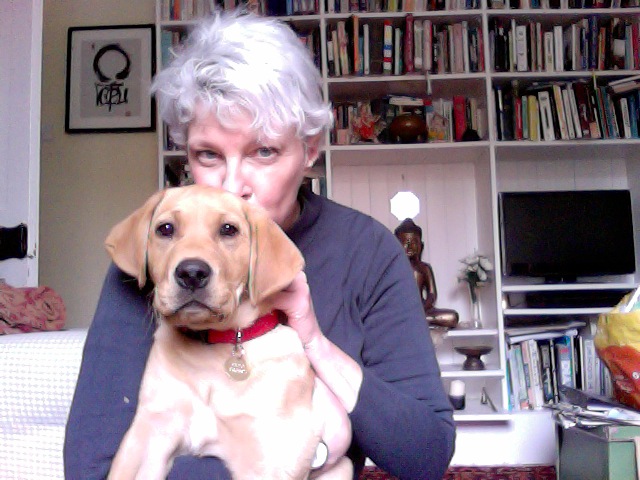
I know, I look tired. In my job (I’m a university lecturer, as well as an author), if you don’t look tired by the middle of November, you aren’t doing it right.

I do it right. I love my students. I mean, I genuinely care about every single one of them; even the ones whose names I can’t remember. Even the (perhaps especially the) horrid, difficult, spiky ones. I have about 95 students I’m teaching directly this year and another 100 or so that I either tutor, mentor or pop in to see and speak to occasionally.  And I love every one of them, even the first-year-boys-who-smell-of-pub.

And they love me back. I give them my energy and they give me energy. Sometimes I get more than I give. Sometimes I give more. It’a not useful to keep track.

It’s the same way in my writing life. I got a nice forward last night.  Someone who I really respect loved something I’d written. They said that word, ‘loved’. And suddenly, I’m full of energy again for my current project. The reader had felt the love I’d put into my writing and had responded to it. My love had gone to her, and so she sent me some back. I feel like I got a good deal out of that exchange and I hope she does, too.

When I wrote that story, I didn’t know if anyone would ever read it. I felt alone and very vulnerable when I wrote it. But I put the love in, anyway, like a message in a bottle. Because, really, what are we doing when we write, if we don’t? What good is it to anyone if we save our energy for ourselves and don’t spill it out into our texts, willy nilly?

There’s no safety in the game of writing. You either do it, or you don’t. And doing it means doing it with…well, there’s no other word for it…love.

Current ms: Blazing Heart

Word Count: 82,945


Out of Control


My hair…

I went for a walk in a rainy forest and it’s completely out of control.

So is my manuscript. I told Sophie I’d have it done by the end of summer. I told myself I’d have it done by Christmas. I’ve been writing it three years. Right now, I don’t know if it will ever be finished.

I have a first half I love and a second half I quite like. I’m trying to write the first half to meet up with the second half. But it won’t go. It won’t do it. My characters keep doing other things, instead.

And this, this maddening state of affairs, is actually a good sign. I finally finished that Graeme Greene book about General Omar Torrijos (I read a few novels in between chunks). Greene talks about talking about characters that begin to do things you didn’t plan, and how it’s a good sign. He was chatting to a girl when he remembers talking about it…which goes to show you. It’s so true, it’s nearly a cliché.

So, it’s a good thing. I keep telling myself. It’s a good thing.

But when I look in the mirror, or when I look at the first part of the second half of my manuscript, I have moments of despair.

Manuscript: To Hide Her Blazing Heart

Word Count: 75,692

On Leaping Over Obstacles

Image


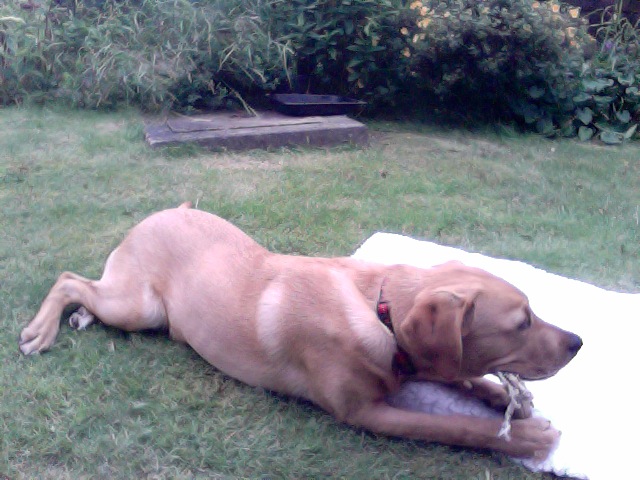
I’m working in the garden of my in-laws’ house this morning. It’s nearly nine o’clock and I’m just about to stop and feed the family. Foyle, my puppy writing companion, has already been fed and is working on a rawhide bone while I write. He’s just done something admirable, which I’ll tell you about later – he’s not just my writing companion, he’s my writing guru.

I’ve been writing about an hour. It’s still going well. If I don’t stay up late again with my far-too-interesting inlaws tonight, I might get to write longer tomorrow. But as long as I write at least one hour, every single day, I know I’ll finish the book by the end of August.

Today, I realised just how flexible and wonderful my close third person, present tense voice is. I’ve never used a voice like it before and I love it for this novel. It makes everything right, everything that niggled before is now radiant and my prose is…well, it’s downright lovely. I’m so happy that I fear I’ll sound smug if I tell you any more…

I don’t sit down with a list of narrative techniques and decide how I’ll write a project – it doesn’t work that way. Sometimes something I am writing just doesn’t feel right. It will usually feel tight, as if my imagination was being constrained by the form.

Today, while I was writing, my in-laws’ longtime neighbour, Elaine, came walking by with her two dogs, returning from the field where Foyle and I had been earlier. Her dogs took exception to Foyle’s presence, and though Foyle put his paws up on the garden wall and leaned over to say hello, very friendly, they growled and snarled at him. Foyle and I went and sat down, but he’d evidently decided that this state of affairs was unsatisfactory, because, after sitting apparently contently for a moment, he suddenly got to his feet, ran to the stone wall and vaulted over it, landing briefly with all four paws on the top before dropping to the other side and taking off after those uppity dogs.

That’s what it feels like to get something right when you’re creating with words. One moment, you are unsatisfied with the way things have turned out. The next, you are flying over an obstacle you thought was insurmountable, chasing those problems away.


Working title: To Hide Her Blazing Heart

Word count: 6983

The Best

This is a post about starting over – about thinking to yourself, ‘no, that’s not good enough,’ and going on to get it right.

I have many role models in my life for this…lately Andy Murray, the British Tennis Champion. Murray is an extremely good tennis player. He’s been ranked in the top ten male singles players since 2007. He’s made it to the finals of all Grand Slam tournaments and once qualified for every final in the same year. But he hasn’t won a single one. Last year, he got a new coach, Ivan Lendl, and this year he nearly won Wimbledon. In his emotional thank you speech, he told his supportive fans that he is ‘getting closer’.

That’s what you need to be a champion – you need to want it badly. You need to be driven to do the best that you can, to be the very best that you can be.

And that means, when you’re writing something wonderful, you may need to start the whole thing over again.

My manuscript was coming along very well. I was storming ahead on writing it. But the voice wasn’t right. The pace wasn’t right. And even though the story is an amazing, breathtaking tale (I can say this, because I don’t feel like I made it up – I feel it was already there, waiting for me), it wasn’t being told as well as it could be.

And that’s not good enough. I’ve started it again, with a new voice. Because being really good isn’t good enough. Not for Andy Murray, and not for me.

Manuscript: To Hide Her Blazing Heart

Word Count: 1346


Writing – Making Space In Your Head

Here I am on the train to Portsmouth.

I’ve looked at perhaps half a million words of marking this week, and it’s only Wednesday. But I’ve also written four thousand words.

The writing is going well.

Why this week, and not the week before last? I was just as busy then, but the idea of opening up my manuscript and working on it was… ridiculous, ludicrous, laughable – take your pick. Utterly unthinkable.

But why? I’ll look at and evaluate some million words of student work this week. Brunel for Monday, Portsmouth for Wednesday, Derby for Friday. I’m working nearly around the clock on Sunday, Tuesday and Thursday, and travelling at least three hours every other day, still looking at work on the train. It’s more work than I marked in the weeks before. It’s bigger, tenser meetings with people I don’t know and who don’t know me.

But the writing is going well.

I think it’s because it doesn’t really matter what you do for the rest of your day; it’s how much of yourself you invest there. I’m naturally keen that I accurately judge the processes of my colleagues at other universities; I’m not slacking on my work as an external. But it’s not as draining as trying to help hundreds of students achieve their best work.

Teaching, if you do it right, is fulfilling and exhilarating and wildly exciting. But it’s also draining. It takes up lots and lots of space in your head. There are all those young faces, looking at you, hoping you will help them to learn something about which they care desperately.  Those young faces get in the way of the other people in my life, the characters in my books. Two weeks ago, they made it hard to see the little huddle of people in my abbey; the people that are, in the midst of terrible challenges, trying to make a life for themselves and their children.

Now that fewer people call me back to the real world, I am able to spend more time in theirs. I have space in my head, and they move back in. That’s where they live, and act out the story I will tell.

Current manuscript: To Hide My Blazing Heart

Stage: Complete Rewrite 1

Word Count: 11,290

It’s Your Ball

Image

Image

We’re watching the Euros in our house. That’s the  European Cup Football Finals, and when I mean football, I mean proper football – soccer.

It’s a bit of dull game, Germany v Portugal, so I’m writing this post while I watch the second half, even though I’ve been looking forward to the match all day.

What it is about writers and sports? Many of the writers I know (and I know loads) are passionate about one sport or another. A well-known YA author I know loves dressage. A TS Eliot Prize-shortlisted poet watches rugby. A great nature writer loves international cricket.

It’s all about international football for me, now, but my first love was baseball. I just read a wonderful novel, The Art of Fielding by Chad Harbach, and it was an amazing book… a world made of words that postively reeked of Deep Heat and sweaty socks. It was written by someone who knew about sports, knew deeply about how sport works; the self-sacrifice, the accommodation every sportsperson must make with terror and pain, the elevated moment when everything depends on you and everyone is watching and it goes wrong or it goes right.

And maybe that’s really why writers love sport. Because we, too, are making our mistakes and having our successes in front of other people. We may think we’re sitting alone in our rooms, but on some level (and much more obviously so once we start publishing) we’re really performing for spectators.

Just like every game is different, every piece of writing is, as well. You can only develop your skills, work hard, hoping that you can manage the technical challenges it will bring. Hemingway saw it as a boxing match or a fishing expedition. I still see it as a green diamond of grass, and a white ball coming down to my glove.

I want to catch it for me. I want to catch it for my readers. And I want to catch it to show all the spectators that I can.

But Gomez has just scored and one of my favourite players, Schweinsteiger, is playing like a dream. I’m going to watch some more; watch how other people do, watch them as they play…as they risk failure in front of other people. Watch them fall down and get up again, watch them sweat and cry and exult.

It makes me feel less alone.

See you in the sky

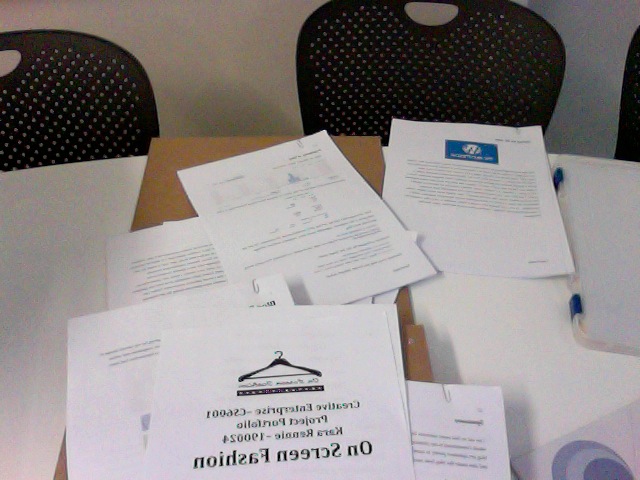
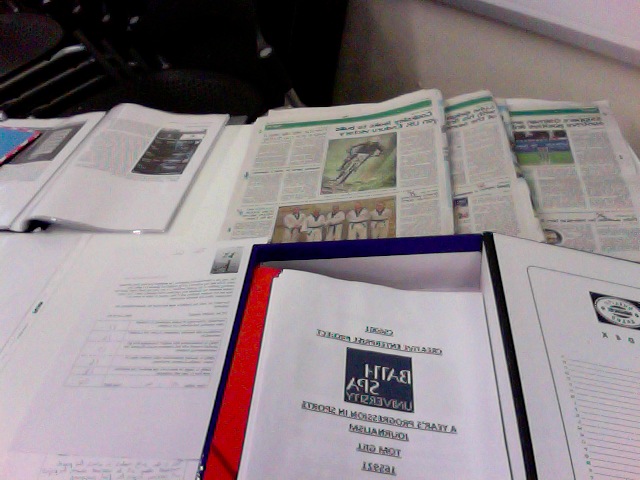
I’m happy. I’m happy because the Vice Chancellor has just come in to see my Creative Enterprise students’ work. I’m happy because I’ve spent all week in this room, talking to my students in their viva voce exams.

It’s inspiring.

It’s inspiring to hear all their new ideas. It’s inspiring to hear them talk about their ethos and morality and their own sense of aesthetic. And it’s simply lovely seeing young people succeed at something they put their hearts and souls into. When I get out of this room every afternoon, I feel like I could fly.

So, I thought I’d share them here, and let you be inspired, too.

Here’s Kara Rennie’s amazing blog about costume design: www.onscreenfashion.com

Here’s Nina Camacho’s inspiring upcycling blog: www.sohouseproud.com 

Here’s Tom Gill’s sports journalism: www.beyondthedugout.co.uk

and Eve Beddow’s work to raise awareness and funds for Lupus UK: http://kalauk.org/  

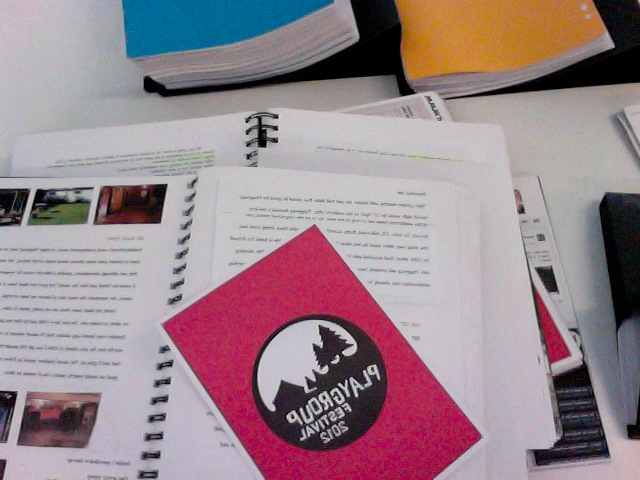
and Claire Holmes’ amazing event: www.playgroupfestival.com

I wish I could show you more…you’re missing out on some wonderful people and amazing projects. And what it does for me is amazing, too. I just want to run out of here and make things; make whole worlds, write and write and write. There are points, during the year, when I wonder why I do this work. And then I get to this week, and I know. My spirits soar and I just take off into the sky.

Some of these students were nothing special. Some of them made marks in the 50s and 60s and tootled along the university system. And then they get just a little encouragement to try something of their own and they…well they fly! I’m giving out a 90 this year. I’m giving out two other marks above 85%. And for a university culture that calls a 70% an A, that’s pretty darn mega.

What does that mean for you? Two things, I think. Listen to the young people around you, firstly, and try and hear what they are doing. Sometimes, with a little tiny bit of help, they can do so much more. And also, notice what happens when you get some support yourself.

I’ll see you up in the air.

How We Talk About Ourselves

I just saw a post from one of my home-town buddies. She was an amazing songwriter in the 80s and 90s and someone had written a retrospective of her career, because she was the judge of a songwriting competition. She posted the retrospective on facebook…and then ended up talking at length about how and why she’d lost the same competition, 25 years ago.

I mean, here was this great write up but she just couldn’t be positive about it. That’s what my husband says I do – ‘you talk yourself down’ he says. Maybe that’s just the Midwestern girl in me. Garrison Keillor once said that the proper way for a Midwestern man to announce to his friends that he just bought a fishing boat is to sigh and say, ‘Well, I guess I’d better start looking for a trailer.’

The whole issue of writerly promotion is fraught with difficulty and peril. My colleagues and I have been emailing about it all day. Truman Capote said, ‘A boy must peddle his books,’ but I’m not sure we all want to, or in fact can, peddle. I can sell anything to anybody, but I get terribly embarrassed talking about my own work. And because I’m embarrassed, I’m not all that great at it, I don’t think.

And the whole Publishing industry is in such flux… I’m not sure anybody knows anything right now. I don’t know if pretending you’re the greatest thing is all that useful to people worrying about their jobs.

I think I’ll stick to writing the stuff, and see where that gets me. Oh, and if you’re at a literary function, you’ll find me by the onion dip, if you want to talk. I’ll be looking all confident and happy, but don’t let that fool you…

Robbing Time

I’m working all May on marking. It’s Thursday, my movie day, and I haven’t even showered yet (it’s nearly noon) because I’ve been marking flat out since seven am. I’m marking, sending reminders for students to put their work up on the virtual learning environment, making little voice recordings of feedback, and coaching staff and students on upcoming assessments. I’m also dealing with the inevitable student complaints and trying to make sure that I’ve been fair, they’ve been fair and that nobody in my care will miss graduating because I didn’t work hard enough and quick enough.

If I work all of May and get my marking done, I’ll be able to write all of June and July. That’s right. I’ll spend every day with my heroine, as she remembers all the events of her past and makes the decisions for her people’s future. And that means, I’ll finish my current book and Sophie will have yet another project to send out to editors for me.

I’m robbing myself of time now, so that I can have more in the future. I’m investing time now, so that I can draw it out again then.

And isn’t that what writing is, really, anyway? Don’t we spend our lives, scribbling away, so that our voices and ideas live on? My books go places I’ve never been, meet people I’ve never met. When I’m dead, they might still be read. Some dusty shelf will be cleared and someone will pick it up and open the page and…I’ll be getting back some of the time I invested in its pages…

Knowing Your Breed

I’ve just been for a walk with Foyle, our 3 month old Labrador Puppy. It was our first walk to the other side of the river, where we met a lovely West Highland Terrier named Sam. He and Foyle were playing happily and Sam’s owner and I were chatting when another pair of Westies arrived and were let off the lead to join the game. Then another arrived and its owner smiled and undid the lead on its leash. There was my golden lab puppy, suddenly surrounded by a sea of white West Highland Terriers. One of the Westies hated puppies, and though Foyle laid down and showed his tummy, it kept lunging at him until he cowered at my legs. I actually had to lift Foyle away from his tiny little teeth.

As we walked away, waving to the nice doggies with the nice owners (and inwardly cursing the nasty one), Foyle saw two labradors on the other side of the river and heaved a tremendous sigh. He’d spent Monday with his mother, grandmother and two siblings and he clearly missed hanging out with his own breed.

Knowing your own breed is important for writers, too. It’s important to know who you are and how that relates to your writing. Not so much because it helps your writing process, but because it helps you, as a writer, to establish yourself, to talk about your work intelligently and to communicate the worth of what you are writing to other people.

Even after seven books, I’m still not good at this. I’m still not sure I’ve found my breed…and I’m not the only one. I was talking to a mate the other day – another successful writer. She was saying that she doesn’t frame the discourse of her work properly; that she thinks she misses out on things because she doesn’t talk about her work in a way that allows other people to see who she is and where she fits.

I want to know, like Foyle, when I’ve been bitten because I’m playing with the wrong bunch. I want to know what I’m going to look like, when I grow up. I want to know my breed.