Writer on a Train: Home

Photo on 2013-06-18 at 09.30


Well, I’m home. I’m charging my bike’s battery in the other room. I charged mine last night. I slept all the way through until seven o’clock.

I haven’t written a word.

I’ve swept the floor, done the dishes, printed off a few things for my daughter. I’ve answered over forty emails and talked to the nice  man who is going to make us a new front door. I’ve also read Matt Haig’s The Humans (if you haven’t, get  it as soon as possible). I’ve had three glasses of good Californian Cabernet Sauvignon (my husband tends to express his emotions through wine) and made a rather tasty tomato and basil risotto.

But I haven’t written anything. And I won’t today.

All that careful organisation of my time that I wrote about yesterday hasn’t happened. And I feel, although I’ve done all the above, that I’ve failed. I’ve had too many times like this lately, too many days when I fail to write. There is a reason all my writing heroes, when I was a child, were men. I’d read The Obstacle Race by Germaine Greer, but I still found myself, once my daughter began attending school, trying to cram a ten hour working day (as lecturer and writer) into five or six hours.

That hasn’t been good for me or my work, or my writing. It hasn’t been good for my husband (who actually does a great deal of the housework). It was good for my daughter, who strenuously resisted any form of after-school care that wasn’t mine, but she is old enough now to understand.

I’m home. But home has to change.

The academic year is ending. I have a month to get systems in place before my mother comes for a visit. Cleaner, someone to do the ironing. Shed built. It’s been easy to be me on the road, now I have to do the hardest thing of all – learn to be me as a mother and a wife.

I won’t be blogging every day. But I’ll let you know how it goes.

Writer on a Train: Taking Pains

Photo on 2013-06-13 at 15.03


It’s a hard thing for students to understand: ‘Work may be technically correct and tell a coherent narrative and still not achieve a first class mark.’

You can write perfectly nicely and tell a story perfectly well and still not be any good.

Finding out whether or not you are any good is the main reason people do higher degrees in Creative Writing. In fact, talking about whether or not something is any good is the main reason Creative Writing exists as an academic subject. In the early 1980s/late 1970s English Literature became supremely uninterested in whether or not writing was any good. I can remember it vividly, because it happened to me in such a personal way. In the early 1980s, I was such a good BA Eng Lit student that I was urged to take classes at graduate level.

I got on well with the New Critics (who were Old Critics by then). In particular, I loved Cleanth Brooks. I felt he had my back and I had his. But suddenly, I was confronted by a whole different language. It was a WWI – WWII American Fiction seminar. We were reading A Farewell to Arms. And suddenly, instead of talking about narrative structure or characterisation or anything else I was prepared to discuss, we started talking about patriarchy, hegemonist masculinity. With effort, this became of tepid interest. But truly, all the fun of English Literature  had gone. I ended up taking far more distributive hours than I needed and inadvertently graduated with a minor in Geography.

So the ‘is in any good’ness is important, not just to my subject, but to me, personally. It’s the whole of my life that is in question: I am mostly, really, made up of text. When I die, I would like this question to be in some way answered.

At times i have thought, ‘Hell, yes, I’m brilliant.’ At times I have thought, ‘The reason you are obscure, Mimi, is that you are no damn good.’ I have rushed some work in the past. I have written quickly in order to feed my family and pay my mortgage. But I’ve written some really good stuff, too. Life is short and I’m over 50. I’m  not going write anything but my best ever, ever again.

A friend is submitting work to agents and getting rejections. And it hurts. I have realised I need to rewrite, not revise Hospital High, a memoir, into Losing My Voice, a fictionalised account of my death in a car accident at 14.  That hurts, too. I didn’t want to have to do it…there are other things I want to write, too, and I really want to have a new book out next year. But its not enough to write nicely and tell a compelling story. You have to take pains, if you want to be any damn good.

You have to take the pains.


All Change

Photo on 2013-06-05 at 09.33


I’m changing.

I’ve always written in bed. Now, I’m commissioning a writing shed.

I’ve always paid all my writing money into the family account. Now, I’m only paying in a percentage and investing the rest in my own development and promotional activities.

I used to write in the early mornings, and that worked for me. Then my life changed. Now, I snatch bits of time and it doesn’t really work well at all. That’s got to change, too. Hence the shed. I need to be out of the house for the ‘Mum, where’s my socks?’ hour, the ‘I forgot to tell you, I’ve got a tasting tonight and won’t be home until ten,’ hour, the ‘I knew I could catch you if I rang early,’ hour. Now, I’ll be in my shed. You can disturb me for blood, bones and fire…and maybe zombie invasions.

I’m changing. I’m going back to being what I was all along, underneath.

A writer, first and foremost. Every day.

On Doing Stuff We Think We Can’t Do

Photo on 2013-04-30 at 11.44If you had asked me this morning, if I could ride my electric bike up the steep hill to campus without the electric bit working properly, I’d have said no.

You’d have to understand: Firstly, when I died in a car accident, it made my breathing tube very small…I can’t pump air in and out quickly enough for a game of tennis or a run around the block. Then, you’d have to know the bike. It’s a second gen electric bike. It’s mainly steel and it weighs about five million pounds. The battery itself weighs two million. I never bother to lock it up. I just take the battery. If someone steals it, I’ll find it…about ten feet away. The thief will be nearby, holding onto their legs and gasping.

Then there’s the hill.

2003-071-students-on-drive


Here it is, looking lovely. It always looks lovely when you are looking DOWN the hill. Like all horrible cycling hills, it starts with a long, slow gradient that gradually gets tougher and tougher until it is the horrible hill you see in the photo. Then you have a moment and then another gradient begins. It’s like Capability Brown, the Regency garden designer who landscaped Newton Park, thought to himself, ‘One day, people will use bicycles. Let’s make it really hurt.’

So, anyway, halfway up the gradient part, the engine stopped working. I could get it to work for little ten second spurts, but then I’d have to get off and resettle the battery to get it to go again. With a student waiting for me, I had to think strategically…by spurting and then pedalling the beast without help and then just walking/hauling it up the worst bits and then resettling the battery and etc, etc, etc, I finally got to my office.

When I’m out of breath, the scar tissue in my throat makes my breath VERY noisy. People offered me inhalers (they always do). People laughed (they always do this, as well). People looked at me with scorn, as if to say ‘how could you let yourself get so unfit’ (they always do this, too). Sometimes people offer to give me lifts. Sometimes people ask if they should phone an ambulance.

God, it’s humiliating.

But trying hard always is. If you try something you’ve never done before and try really hard to do it, kind people will advise you to stop, or maybe to get professional help. Less kind people will laugh or be scornful.

But it will be you that, eventually, gets to the top of the hill.

Mind you, you might need a little break once you get there…


Something Funny

Photo on 2013-04-25 at 11.49 #4


I’m writing a book that makes me laugh.

I’ve sent the first ten thousand words of my dying-in-a-car-crash rewrite off to Sophie. I’m waiting to see if she thinks I’ve got the narrative voice just right. So, in the meantime, I’m working on another book – a funny book.

I actually laugh out loud when I’m writing it. And giggle almost all the time. I’m writing it with my 11 year old daughter. We make up what happens over our afternoon tea. I go away and write it up and then she reads what I’ve done and asks for edits. It’s more fun than anybody really deserves to have.

For years and years and years, I’ve been trying to be serious and grown up in my work. To be honest, I don’t think that’s worked all that well. And one reason it hasn’t worked all that well is that, although I am well educated and think seriously and deeply about all kinds of current issues and philosophical concepts on which I am fairly well-informed, I’m also rather…silly.

Silly by choice. Silly because, damn it, there’s enough to cry about and be shocked by and worry over in life without me sitting down at the keyboard and adding to it. Silly because I have thought seriously and deeply about all kinds of current issues and philosophical concepts on which I am fairly well-informed.

I’m not silly because I’m too stupid to understand the dark side of life. I’m silly because I think the best thing I can do with my talent is help get my readers through another bloody day.

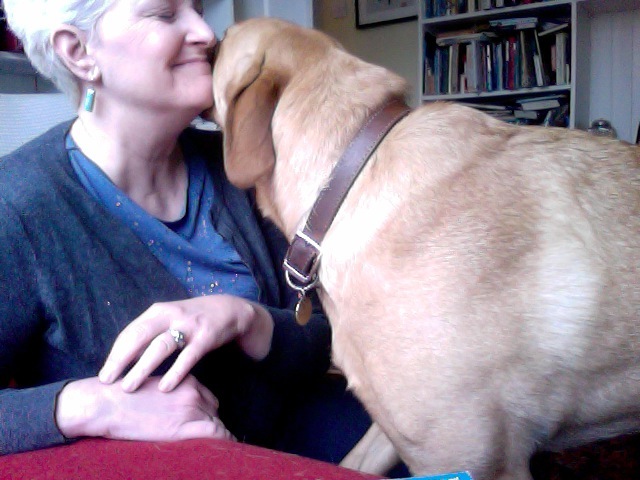
God, I wish I could share this chapter with you right now. The part where the teachers all fall off the back of the stage makes my eyes water with pure joy. Instead, have this selfie of me that got photobombed by the labrador. Hope it makes you smile.


Long Time Gone

Photo on 2013-04-04 at 12.15 #2


I balance my literary life with my other commitments. Of those ‘other commitments’, the largest are work and family. I’ve been away because of family.

In three months, both of my in-laws have died. My husband is an only child – and so I’ve been helping with…with all the stuff that you have to do when someone dies. In a way, there’s a lot of it and it takes forever. And in a way: Poof! It’s all gone.

Death. We don’t talk much about it anymore. When I was a kid in 1960s America, we lived closer to death than we do now. Coffins were open, old people stayed in their families and their neighbourhoods. You saw people decay…you saw the inevitability of what happens. An attractive woman would become ill, age rapidly and still do her shopping and water her flowers and then you’d see her stagger in her garden and then it was her funeral. I remember being led up to open coffins and peeping over the edge, disappointed by how undramatic it was, how normal the deceased looked.

I’m writing about my own death again. When I was 14, I died in a car accident. Of course, I came back! I wrote a memoir about my injury and recovery. Now a publisher wants me to fictionalise it, for a larger readership. It was hard to write and it’s still hard to write…I feel like death is all around me right now, like I can hear a long scythe being sharpened just behind my left shoulder.

Being conscious of our own impending death is, some people say, the main defining characteristic of the human. It is the root of all our neuroses and also of our altruism.

It’s also a great motivator. I’ve got four books on the go at once and I really need to finish some of them, get them out, get them published and let them go. I have other ideas. I have other things to do. And I’m not getting any younger –  none of us are. So I’m starting to wake up just that little bit earlier and work just that little bit longer. As my Irish grandmother used to say, ‘There’s plenty of time to rest when you’re dead.’

The Doctor and The Mate – Friends Every Writer Needs

Photo on 2013-01-10 at 23.51

I’ve just come back from the emergency ward/A&E, and since I’m pumped up full of steroids, I thought I’d share an insight about the writing life I had while I was there.

I have a health condition that I manage by basically ignoring it as much as I can. And that works until once every ten years or so, when it stops working and I need someone with a very specific and acute understanding of throats. And by that time, I need them quite quickly.

And then they do their thing and I’m okay again, which is where we came into the story.

It’s a lot like my new MA student. He is writing a certain kind of book (and if it’s as good as I think it’s going to be, I’ll be telling you about it later). It’s a very specific kind of book, a kind of book not all my colleagues like or read. In an hour together today, we saved his book’s life. It’s going to grow up to be a really brilliant story now.

I was his book’s throat doctor. I knew all the ins and outs of what had happened to it and what we needed to do to get it going again.  And we need people like that, in our writing lives. We need folks who give it to us straight, who say: Take This Particular Steroid Or You Might Die.

But we also need people like my great mate, who has been in and out of a few emergency rooms and specialist wards in her own life. People who will come get you and drive you to the hospital. People who will walk beside you and hold your hand. People who know absolutely nothing about your book (and perhaps won’t even like it or read it) but people who know about you.

People who, when you are saying, ‘I don’t want to take another steroid. That’s three today,’ say, ‘I think you better go ahead and take it. You’re upsetting the doctor.’ People who drive you to McDonalds on the way home and give you a hug once you’re there.

Your book has to work in order to survive. But you have to survive, too.  Sometimes you need to hear the tough advice. Sometimes you just need to hear that someone is behind you, caring that you achieve your dreams.

MS

Hospital High, Blazing

Time

Photo on 2012-12-10 at 19.08

Most of my friends aren’t writers. I know and am fond of a great many writers, but I live in a small market town. My best mates do all kinds of things. We do the same things, too. Most of us go to my church or live on my street or our kids go to the same school in Bath. And they are, frankly, better at all the things we do the same. I’ve been trying to paint my hall for months – one of my mates has almost totally renovated her house in that time. All the mums at school keep saying, ‘Are you all ready for Christmas?’ The answer is no, not at all. Even though I’ve put all my church commitments in my diary, sometimes I forget that I’m meant to be reading or doing something else for the parish. I’m a trial to my great mates, the ushers at the Sunday morning Mass.

I know that they often wonder why I’m so…rubbish.

It’s the reading and writing, of course. And they forget.

Sometimes they say, ‘I don’t know when you do it all.’ And no, they don’t. Because they don’t understand. The writing…and the reading (which takes even more time) doesn’t go around the other elements of my life, like other work would. The reading and writing are the centre of my life. I am, mostly, made up of text. It is how I interact with the world, it is my primary essence. But that’s invisible to my friends. They may notice that there are piles of books everywhere in my house (as well as occupying the whole of one room and three other walls) but they don’t see me reading. They don’t see me writing.

My family knows my dirty secret. My daughter always used to draw me with a book in my hands. My husband calls up the stairs, ‘Mimi! We have to GO. Stop READING!’

It’s not my leisure time. It’s my life. And no, my tree isn’t up, thanks for asking.

Current ms; Hospital High, Blazing Heart

On Stretching ‘Till It Hurts

Photo on 2012-12-04 at 11.48 #3

I like my hair white. God is making my hair white, but he’s too slow. My hairdresser tells me it’s too dangerous and she won’t help me. And she’s right. I regularly destroy the ends of my hair and have to cut them off. And I often burn my scalp, bleaching my hair. I bleached it for two four-hour sessions yesterday and destroyed the ends. (I cut them off this morning.) And it’s still not really white – there’s a bit of yellow left in places. I’ll need to do more purple shampoos before it goes the colour I like.

On the other hand, it IS utterly fabulous.

My daughter, aged 10, is an ambitious dancer. She likes to see The Royal Ballet at Covent Garden (we get cheap seats and book the train months ahead of time). She fully expects to be dancing that well in ten years’ time (although she really is interested in becoming a choreographer). She’s just started training at a Russian Ballet School in Bristol, as well as at our local dance school. The Russian Ballet ask for a great deal more extension than my daughter has, and she’s been stretching assiduously. One day, in P.E. at school, she pulled an adductor muscle in her right leg. She’s having physio on it now, and off dance for the rest of the year.

On the other hand, her ballet has really improved.

Sophie has been in talks with a publisher I very much like, about Hospital High. They’d like me to make it more fictional than memoir, for me to ‘base it’ on my life experiences, but not conform to them. They’d like more about my relationships and about the 1970s setting. It’s a stretch. I might hurt it if I try to do that to it.

But on the other hand, it could be absolutely amazing.

To be amazing, you have to risk. To get better at something is to leave the way you’ve done it before completely behind. You don’t know it will work: you might lose, you might get hurt. But that’s art: being injured is almost guaranteed in ballet. Failing, regularly, is almost guaranteed in writing. You can live in the safety of what you know and do what you always do, I suppose. But it doesn’t sound much like living to me.

Current Manuscripts: Hospital High, Blazing Heart


Chaos and Order in the Writing Life

I meant to write this Thursday. I meant to have my hair done this morning. My husband didn’t really want to run to the Post Office to tax his car before giving two wine tastings in two separate cities (both with flood warnings). I didn’t really want to miss my daughter’s Taster Day reception at the school we are hoping she’ll attend next year, but I mis-read the time and scheduled teaching, instead. Oh, and the house looks like we’ve been burgled.

Chaos.

I can’t write when things are this messy and chaotic.

But they get this way, when I’ve been writing.

When things are going well with my writing, I don’t really notice that I tracked in half a ton of twigs, rosemary needles and dead leaves when I go out to garden and think about what happens next in my latest book. I don’t care that I have forgotten all the paperwork to do with my daughter’s school activities. I’m not bothered about dirty dishes or the fact that we still haven’t started the decorating (and the walls look horrid). I don’t answer my phone calls and I put emails about things I should do to one side, to think about ‘later’. But then, one day, I go to write and I am noticing it all. I think to myself, ‘Really! Why is this house so horrible? I can’t work in an environment like this! I can’t deal with all these people, phoning me, wanting me to do things, asking me questions!’

I get quite shirty about it.

But it was my fault (writing too early and then too tired to cook at dinner time) that there are big pizza boxes on the kitchen counters. It was me that left all my teaching books scattered on the dining room table (getting an hour or so in on the manuscript before my daughter came home). It was me that didn’t care about filing my class registers. Now it’s time to get out the shovel and clean the place, and spend a few hours on admin, so that my writer self can get back to work…and mess it all up again.

She’s horridly selfish. But I love her.